
# Chuseok in Korea: Autumn Palaces, Quiet Villages, and the Best Places to Go
Chuseok is one of the most special times to visit South Korea. Families travel home, traditional food fills the markets, and cities slow down just enough for you to notice details you might otherwise miss.
The Korea Tourism Organization’s **Explore Korea** recommendations are a helpful starting point, but my favorite Chuseok memories came from mixing famous places with slower stops: an early walk around an old palace, a bowl of noodles in a neighborhood restaurant, and a train ride out of Seoul to see a different side of the country.
## The Vibe & When to Go
Chuseok usually falls in **September or October**, depending on the lunar calendar. Autumn is one of Korea’s nicest travel seasons. Seoul is generally mild during the day, with cooler mornings and evenings, while Busan and Jeju often stay a little warmer. The leaves may just be starting to turn around Chuseok, with richer autumn color arriving later in October.
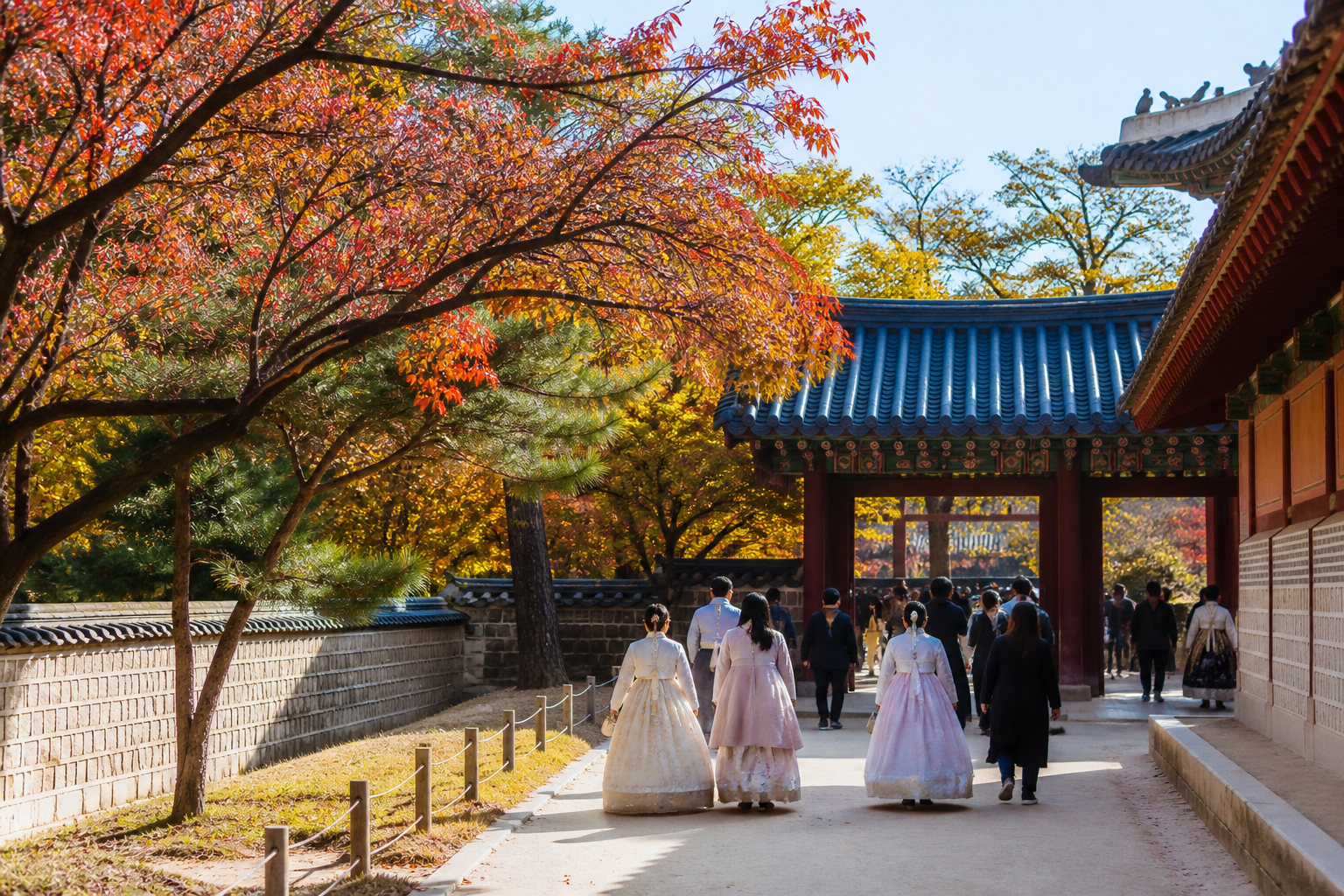
The holiday itself can be busy. Koreans travel across the country to visit relatives, so trains, buses, and major highways fill up. Some small restaurants and independent shops close for a few days. That sounds inconvenient, but there is also something lovely about it: parks are full of families, people wear hanbok near the palaces, and traditional holiday events bring old customs into the middle of modern city life.
If you want fewer crowds, arrive a few days before Chuseok or stay after the main holiday weekend.
## My Top Places to Visit
### 1. Seoul’s Palaces and Bukchon
I like starting in **Gyeongbokgung Palace** early in the morning, before the nearby lanes become crowded with photography groups. The palace courtyards feel spacious and calm, especially under the clear autumn sky. Renting a hanbok is not essential, but it can make the visit more fun—and visitors wearing traditional dress are often eligible for free palace admission.
From there, walk toward **Bukchon Hanok Village**, but keep your voice low in the residential lanes. The prettiest views are not always the busiest ones. I usually skip the most crowded photo streets and wander toward the smaller alleys around Gahoe-dong, where tiled roofs appear between ordinary homes and cafés.
For lunch, look around **Insadong** or Jongno for kalguksu, mandu, or a simple set meal. During Chuseok, check opening hours before setting out because some family-run restaurants take several days off.
### 2. Jeonju Hanok Village
Jeonju is one of the best places to experience Korea’s traditional side without leaving behind good food. The **Jeonju Hanok Village** is touristy in parts, but it becomes much more pleasant in the early morning. I loved walking past the curved roofs while the streets were still quiet, then stopping for a warm bowl of kongnamul-gukbap.
The area is known for **bibimbap**, but don’t stop at the first restaurant with a large English menu. Walk a few blocks away from the main lanes and look for places filled with local families. Jeonju’s makgeolli alleys are another fun evening option, although the servings can be much larger than expected because dishes arrive alongside the drinks.
From Seoul, the KTX train takes roughly one and a half to two hours, depending on the service. Reserve seats early around Chuseok.
### 3. Busan’s Coastal Walks and Markets
Busan gives the holiday a different rhythm. The sea air, steep neighborhoods, and busy food markets make it feel less formal than Seoul.
I would spend one morning at **Gamcheon Culture Village**, arriving as early as possible. The colorful houses are charming, but the village is also home to residents, so it is better to treat it as a neighborhood rather than a theme park. Afterward, head toward **Jagalchi Market** for seafood or wander through nearby Gukje Market for snacks and inexpensive gifts.
For a quieter afternoon, take the coastal train or walk around **Haeundae** and **Cheongsapo**. The ocean views are especially nice in autumn, when the humidity drops. Just remember that Busan is spread out; crossing the city can take longer than it looks on a map.
### 4. Nami Island or a Mountain Day Trip
If you are staying in Seoul for several days, a day trip into the countryside gives you a welcome break from palace streets and shopping districts. **Nami Island** is popular and can be crowded during autumn, but the tree-lined paths are beautiful. Go on a weekday and arrive early.
For something less polished, consider **Bukhansan National Park**, which is much closer to Seoul. Even a short trail gives you pine trees, rocky viewpoints, and a glimpse of how quickly the city disappears behind the hills. Wear proper shoes; some sections are steeper and more slippery than they look in photos.
## Practical Travel Advice
### Getting There and Visa
Most international visitors arrive through **Incheon International Airport**, with Gimhae Airport serving Busan and Jeju International Airport handling many domestic and regional routes.
Visa and entry rules depend on your passport. Some nationalities can enter visa-free for short stays, while others must apply for a tourist visa. **K-ETA requirements and temporary exemptions can change**, so check the official Korea Visa Portal and K-ETA website before booking. Your passport should have enough validity for your trip, and you may be asked for an onward or return ticket.
For Chuseok travel, book flights and domestic trains earlier than you think you need to. KTX tickets can sell quickly, particularly between Seoul, Busan, and Jeonju.
### Where to Stay
– **Myeongdong:** Convenient for first-time visitors, shopping, and airport connections. It can feel busy and commercial.
– **Jongno or Euljiro:** Better for palaces, traditional neighborhoods, cafés, and evening food.
– **Hongdae:** Good for younger nightlife, music, casual restaurants, and a lively atmosphere.
– **Haeundae in Busan:** Best for beaches and a more relaxed resort feel.
– **Seomyeon in Busan:** A practical base for transport, restaurants, and exploring different parts of the city.
– **Jeonju Hanok Village:** Choose a hanok guesthouse for atmosphere, but expect firmer bedding and fewer modern facilities.
During Chuseok, accommodation prices can rise and smaller guesthouses may close briefly. Confirm your check-in dates directly with the property.
### Getting Around
Korea’s public transport is excellent, especially in Seoul and Busan. Buy a **T-money card** at a convenience store or airport and use it on subways and buses. Google Maps is not always reliable for walking and transit directions, so I usually use **Naver Map** or **KakaoMap** instead.
For taxis, **Kakao T** is the most useful app. Subway stations are usually well marked, but many involve stairs, so pack light if you are changing lines often. In Seoul, walking between nearby neighborhoods is often faster and more enjoyable than taking a short taxi ride.
## Realistic Costs and Local Tips
South Korea uses the **Korean won (KRW)**. A rough daily budget, excluding international flights, looks like this:
– **Budget traveler:** ₩60,000–₩100,000 per day
Hostel bed or simple guesthouse, local meals, public transport, and a few inexpensive attractions.
– **Mid-range traveler:** ₩150,000–₩250,000 per day
Comfortable hotel, café stops, restaurant meals, taxis, and occasional paid experiences.
Tipping is not expected in Korea. At restaurants, cafés, taxis, and salons, simply pay the listed amount. Some restaurants add service charges, but you do not need to calculate an extra percentage.
A few things that saved me money and frustration:
– **Eat where office workers eat.** Look for busy lunch spots away from the main tourist streets. Set meals and soup restaurants are usually filling and reasonably priced.
– **Carry a small amount of cash.** Most places accept cards, but traditional markets, tiny snack stalls, and some transit machines are easier with cash.
– **Check holiday hours on Naver Map.** A listing can say a business is open even when the owner has closed for Chuseok.
– **Buy water and snacks at convenience stores.** They are everywhere, clean, and often much cheaper than hotel shops.
– **Avoid booking every train at the last minute.** Around Chuseok, domestic travel is a serious operation. Reserve KTX seats as soon as your route is fixed.
– **Take shoes seriously.** Palace courtyards and village streets are easy, but mountain paths and long market walks can add up to many kilometers.
Chuseok is not the simplest time to travel around Korea, but the holiday gives the country a warmth that is easy to miss on a tightly planned trip. Leave room for closed doors, crowded trains, unexpected snacks, and quiet morning walks. Those unplanned moments were the parts I remembered longest.
KEYWORDS: Seoul palace, Korean autumn