
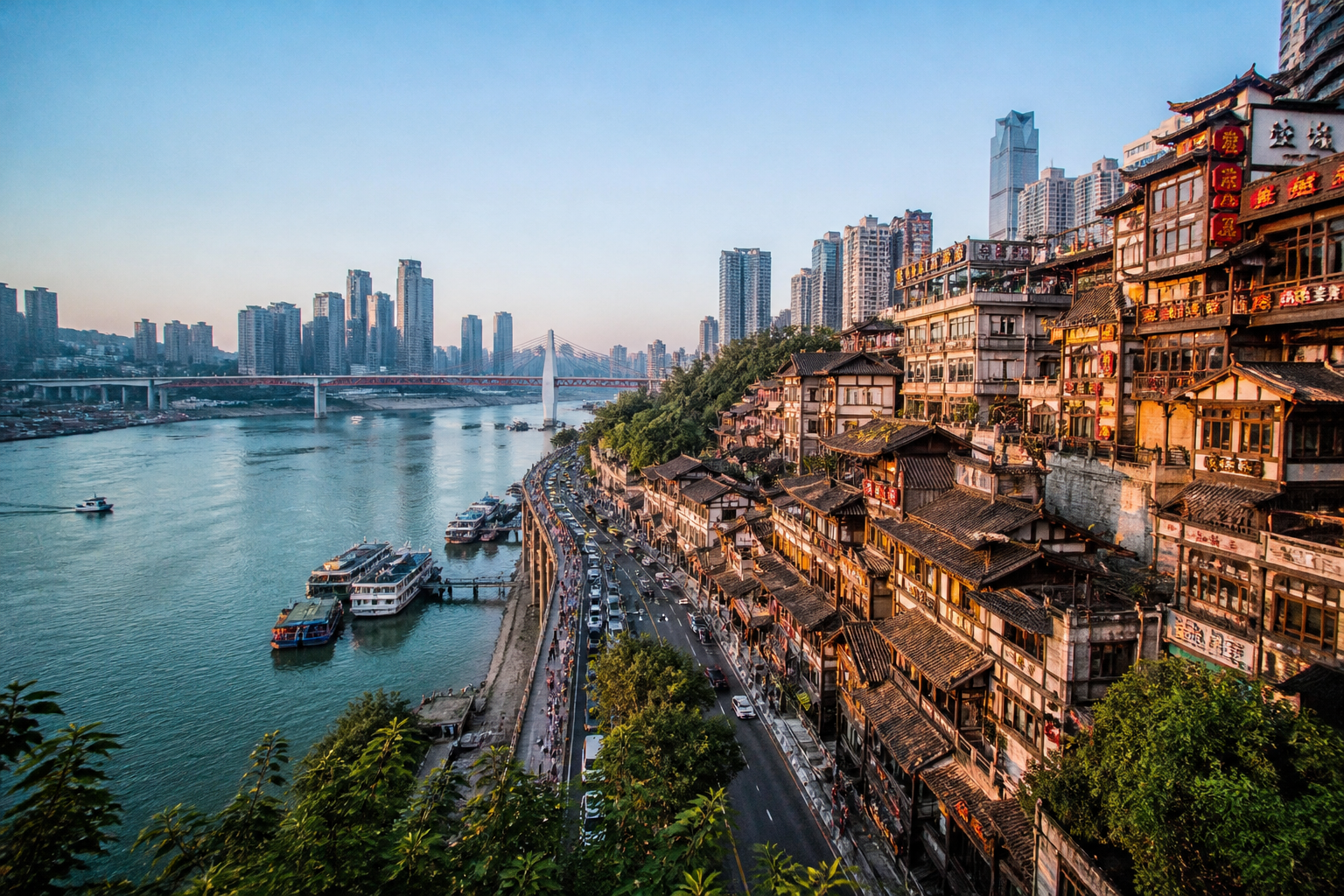
# Chongqing Travel Guide: Hotpot, Hilltop Views, and the China City That Never Sits Still
## The Vibe & When to Go
Chongqing feels less like a city built on a grid and more like a giant, glowing maze climbing up and down the hills. One minute you’re beside the Jialing River; the next, you’re walking through a residential lane several floors above street level. Metro trains disappear into apartment blocks, bridges stack over one another, and even a short walk can turn into a small workout.
In spring, the weather is usually mild and damp, with comfortable temperatures for wandering but plenty of cloudy skies. Chongqing is famous for its mist, and honestly, the soft gray light suits the city. The hills, rivers, and neon signs look especially atmospheric after rain.
Summer is hot, humid, and famously sweaty. Autumn is one of the most pleasant times to visit, while winter tends to be cool and damp without much indoor heating. I’d choose spring or autumn if you want to spend long days outside.
The best reason to visit now is that Chongqing still feels like a real working city rather than a collection of sights arranged for visitors. You’ll see office workers eating noodles beside grand viewpoints, grandparents chatting outside old apartment buildings, and young locals filling tiny cafés and hotpot restaurants late into the night.
## Must-See Spots: My Top Picks
### 1. Hongya Cave After Dark
Hongya Cave is Chongqing’s most recognizable sight, and yes, it can be crowded. Still, seeing the wooden buildings light up beside the river is one of those moments that feels genuinely special.
Go just before sunset so you can watch the colors change. Walk through the upper levels, but don’t spend all your time inside the shopping areas. The best views are from across the river near Qiansimen Bridge, or from the riverside walkway below.
A little practical advice: the building is much bigger and more confusing than it looks. Elevators can be packed, and what appears to be the “ground floor” may not actually be street level. Wear comfortable shoes and give yourself time to find your way out.
### 2. Liziba Station and the Mountain City Trails
Watching a metro train pass through the middle of an apartment building at Liziba is a quick but memorable stop. There’s a viewing platform outside the station, and you’ll probably only need 15 or 20 minutes there.
Afterward, I prefer wandering through Chongqing’s older hillside neighborhoods. The Mountain City Trail near Shibati and the old city center has steep stairways, small food stalls, laundry hanging from balconies, and occasional views over the river.
This is where Chongqing makes the most sense to me. The city’s famous skyline is impressive, but the ordinary lanes between the major sights are often more interesting. Keep your map open, because the roads can twist in unexpected directions.
### 3. Jiefangbei and the Late-Night Food Streets
Jiefangbei is the busy heart of central Chongqing, with shopping malls, restaurants, street snacks, and the People’s Liberation Monument at its center. It’s easy to dismiss as too commercial, but I like coming here in the evening when office workers start filling the restaurants.
Try small bowls of **xiaomian**, Chongqing’s spicy noodles, or grilled skewers from a modest-looking shop. You don’t need to choose the most famous restaurant in the area. If a place is full of local families and the menu is mostly in Chinese, that is usually a good sign.
For hotpot, expect plenty of chili, oil, and Sichuan pepper that leaves your mouth tingling. Ask for a **yuanyang guo**, or split pot, if you want a mild side. Even then, the “mild” broth may still have a little heat.
### 4. A River View from the Yangtze Cableway
The Yangtze River Cableway gives you a short ride between Yuzhong and Nan’an, with views of the water and the dense city rising around it. It’s more than a photo opportunity: locals have used it as a practical way to cross the river for years.
Try to go earlier in the day or reserve a ticket if the system allows it. Lines can become long around sunset. If the wait is excessive, take the metro or a ride-hailing car across the river and enjoy the view from a riverside promenade instead.
For another perspective, take an evening river cruise. The lights are beautiful, but I’d compare prices carefully before booking. Some basic cruises offer nearly the same view as more expensive packages.
## Practical Travel Advice
### Getting There & Visa
Chongqing Jiangbei International Airport has domestic connections across China and international flights to selected Asian cities and other destinations. From the airport, Metro Line 10 connects with the city, though the ride and transfers can take time if you are staying in the central districts.
High-speed trains are also useful. Chongqing North Railway Station handles many major routes, while Chongqing West Railway Station serves other long-distance services. Check your ticket carefully—these stations are not interchangeable, and reaching the wrong one can take a while.
Visa rules depend on your passport and the purpose of your trip. Some nationalities may qualify for visa-free entry for limited stays, while others need to apply for a tourist visa before departure. China also has transit-without-visa options for eligible travelers passing through certain cities, but the permitted routes, airports, and stay lengths can change.
Before booking, check the latest information from the Chinese embassy or official immigration website in your country. Keep hotel reservations, onward tickets, and travel insurance details available in case they are requested.
### Where to Stay
– **Jiefangbei:** Best for first-time visitors who want restaurants, shopping, Hongya Cave, and easy access to central sights. It can be noisy and more expensive.
– **Nan’an:** A good choice for river views, cafés, and a slightly calmer atmosphere. It is handy for the cableway and riverside walks.
– **Guanyinqiao:** Popular with younger locals, with plenty of food, nightlife, and shopping. It feels more modern and less focused on sightseeing.
– **Shapingba:** Often better value, with universities, local restaurants, and good metro connections. It’s a little farther from the main central sights.
– **Near Chongqing North Railway Station:** Convenient if you are taking an early train, but not my first choice for a longer stay.
I usually choose somewhere within a short walk of a metro station rather than paying extra for a famous landmark view. Chongqing is spread out, and a convenient station saves more time than a fancy address.
### Getting Around
The metro is the easiest way to cover long distances. It is affordable, clean, and often much faster than sitting in traffic. Download a map before you arrive, since underground connections can be confusing.
For rides, **DiDi** is the main local app. It can be used through some international payment setups, or through Alipay and WeChat depending on your account. Taxis are available too, but showing a Chinese address or destination on your phone makes things much easier.
Walking is rewarding but rarely flat. A route that looks like 15 minutes on a map may include stairs, steep slopes, and several levels of the city. Build in extra time, especially if you’re carrying luggage.
Alipay and WeChat Pay are widely used. Set them up before traveling if possible, and carry a small amount of cash as a backup. Some smaller stalls may not accept foreign bank cards directly.
## Real Costs & Local Tips
The currency is the **Chinese yuan**, usually written as RMB or CNY. Tipping is not normally expected in restaurants, taxis, or cafés. You can leave a small extra amount for exceptional service, but nobody will expect it.
### Rough Daily Budgets
**Budget traveler: RMB 180–300 per person**
– Simple guesthouse or hostel: RMB 70–150
– Noodles, rice dishes, and snacks: RMB 40–70
– Metro and occasional short ride: RMB 15–40
– Low-cost attractions and drinks: RMB 20–40
**Mid-range traveler: RMB 450–800 per person**
– Comfortable hotel: RMB 250–500 per room
– Hotpot or sit-down meals: RMB 100–200
– Transport and entry fees: RMB 40–100
– Coffee, snacks, and an occasional river activity: RMB 50–100
Prices rise during public holidays, especially around the Spring Festival, Labor Day, and National Day. Book trains and hotels early if your trip falls during one of those periods.
### A Few Ways to Save Money and Avoid Hassles
– **Eat away from the most famous viewpoints.** Restaurants directly around Hongya Cave and Jiefangbei often charge more. Walk two or three blocks into a residential area for better-value meals.
– **Use the metro for cross-city trips.** Traffic can be painfully slow, especially during rain or evening rush hour.
– **Order small portions first.** Chongqing servings can be generous, and hotpot ingredients add up quickly. You can always order more.
– **Check the location of your hotel carefully.** A hotel may look close to a landmark on a map but be separated by a river, steep hill, or a road with no easy crossing.
– **Carry tissues and wet wipes.** Many small restaurants have limited supplies, and spicy food has a way of creating emergencies.
– **Don’t assume every neon-lit building is Hongya Cave.** Chongqing has plenty of dramatic riverside architecture, and some photo stops nearby offer similar views with fewer crowds.
Chongqing is not the easiest city to understand on your first day. The directions can be strange, the hills are tiring, and a building’s “first floor” may not be where you expect it. Give yourself time to get lost a little. Once you stop trying to make the city behave like a flat, orderly map, its charm becomes much clearer.
KEYWORDS: Chongqing skyline, Hongya Cave