
# A Quiet Walk Through Morang’s Bamboo Grove: Local Flavours, Green Paths, and Useful Travel Tips
## The Vibe & When to Go
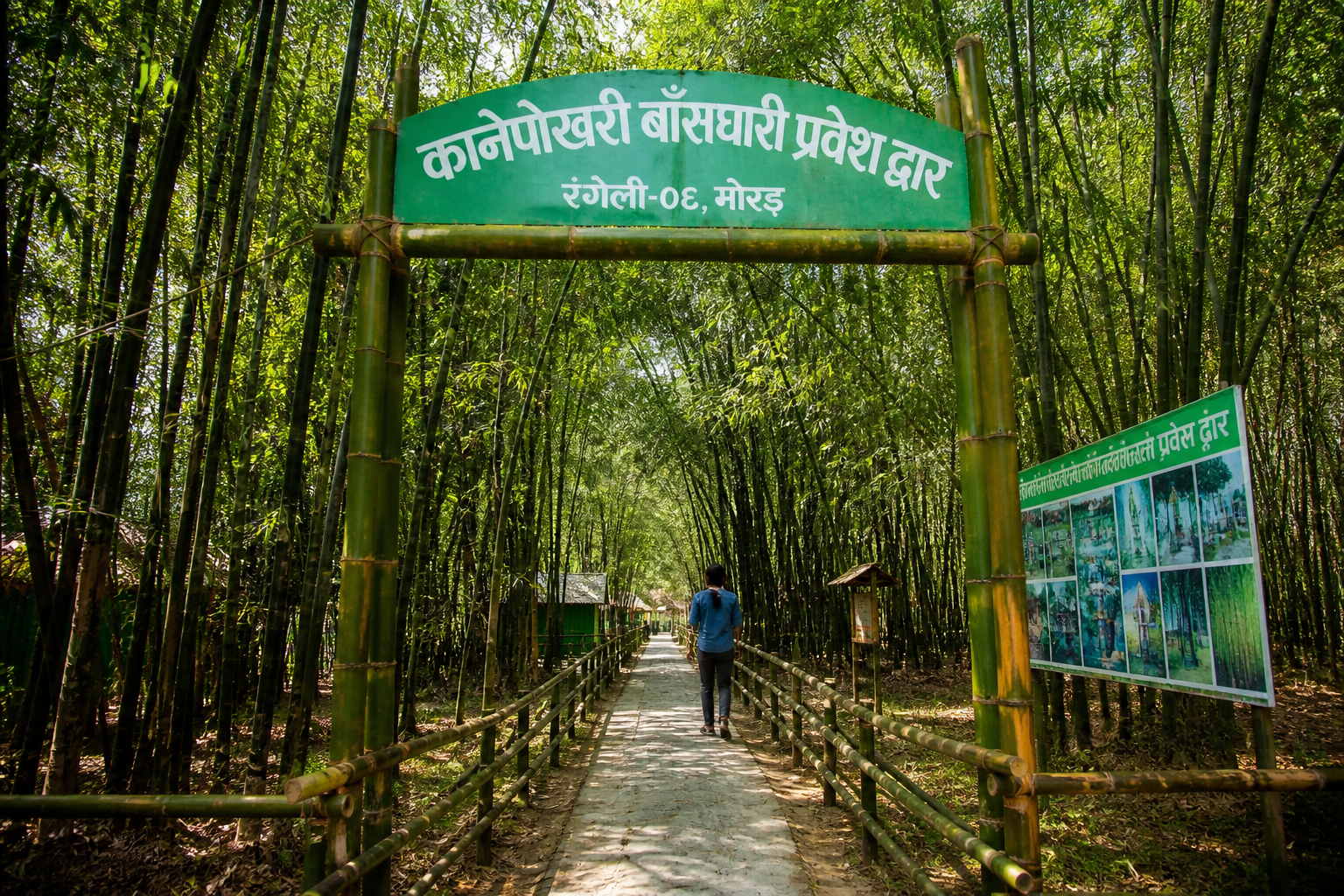
The bamboo grove in **Kanepokhari, Morang** feels pleasantly unhurried. You hear leaves brushing against one another before you see much of the forest, and the tall bamboo creates cool, shifting shade even when the Terai sun is strong. It is not a polished theme park; that is part of its charm. The area still feels connected to nearby villages, farms, ponds, and everyday local life.
The grove has become a popular eco-tourism stop for people from Morang, Jhapa, Sunsari, and Biratnagar. Families come for short walks and picnics, while photographers usually arrive in the softer morning or late-afternoon light.
**October to April** is the easiest time to visit. The weather is generally drier, the paths are more comfortable, and winter mornings can be beautifully misty. From June to September, the bamboo looks especially green, but heavy rain can make the ground muddy and bring mosquitoes. If you visit in the warmer months, go before 10 a.m. or after 4 p.m.
## Must-See Spots: My Top Picks
### 1. The main bamboo paths
The best part of the visit is simply walking beneath the bamboo canopy. Some sections are open and easy to explore, while other paths narrow into quieter corners. I would not rush this place. Slow down, listen to the bamboo moving in the breeze, and look for the small changes in light between the stalks.
Wear shoes with a decent grip, especially after rain. Sandals are fine in dry weather, but the paths can be uneven.
### 2. The open picnic and gathering areas
Local visitors often bring food and sit together in the open spaces around the grove. This is a good place to watch how people use the site—not just as a photo stop, but as a relaxed community outing.
If you bring your own snacks, carry everything back out. Waste management can be a challenge at newer recreational sites, and keeping the grove clean makes a real difference.
### 3. Kanepokhari’s village landscape
Don’t leave immediately after seeing the bamboo. The surrounding area has the quiet character of rural Morang: small roads, cultivated fields, ponds, bicycle rides, and homes shaded by trees. A short walk or slow drive around the nearby villages gives you a better sense of the place than staying only at the main entrance.
Ask locally before walking through private farmland. Most people are friendly, but a simple greeting and permission go a long way.
### 4. Sunset and the quieter edges
The centre of the grove can become busy during holidays and weekends. I prefer wandering toward the less crowded edges in the late afternoon, then finding a safe open spot to watch the light fade.
Avoid walking deep into unfamiliar areas after dark. Facilities and lighting may be limited, and the grove is more enjoyable when explored in daylight.
## Practical Travel Advice
### Getting there and visa information
Kanepokhari lies in Morang in eastern Nepal, close to the **Mahendra Highway**. The easiest route for most travellers is:
– Fly from Kathmandu to **Biratnagar Airport**
– Hire a taxi or arrange a local vehicle toward Kanepokhari
– Alternatively, take a bus along the Mahendra Highway from Biratnagar, Itahari, or nearby towns, then use a local taxi or auto-rickshaw for the final stretch
Travel time depends heavily on traffic and road conditions. From Biratnagar, allow several hours for the full journey rather than relying on a tight schedule.
International visitors generally enter Nepal with a passport valid for at least six months and a tourist visa. Nepal offers visa on arrival at Tribhuvan International Airport in Kathmandu, and some travellers can also apply online before flying. Visa rules and fees can change, so check the official Nepal immigration website before your trip. You do not normally need a special permit just to visit the bamboo grove, but ask the local tourism office if you plan to camp, film commercially, or organise a larger event.
For domestic flights, book ahead around Dashain, Tihar, school holidays, and weekends. Morning flights are often a safer choice because delays can build later in the day.
### Where to stay
There are limited tourist facilities directly around the grove, so I would choose a base according to your travel style:
– **Biratnagar:** Best for hotels, restaurants, airport access, and a more convenient first or last night.
– **Itahari:** A practical highway stop with transport connections and plenty of basic hotels.
– **Kanepokhari and nearby villages:** Better for a simple rural stay or homestay, if one is available locally. Arrange this before arriving rather than assuming you can find a room on the spot.
– **Dharan:** A pleasant option if you want to combine the bamboo grove with hill views, temples, and a livelier food scene.
For a relaxed trip, I would stay in Biratnagar or Itahari and make Kanepokhari a day visit.
### Getting around
Inside the bamboo site, walking is the main way to explore. Outside it, transport is more practical than public sightseeing infrastructure:
– Local buses and microbuses are inexpensive but can be crowded.
– Auto-rickshaws are useful for short distances.
– Taxis are the simplest option for a day trip, especially if you are carrying bags or travelling with family.
– Pathao and inDrive operate in some larger eastern Nepal towns, but coverage may be unreliable around Kanepokhari. Download the apps before leaving town, but keep a local driver’s phone number as a backup.
– Ask your hotel to help arrange a car for the return journey. Mobile signal and ride availability may be weaker around the grove.
## Real Costs and Local Tips
Prices vary by season and by how far you travel, but these are sensible estimates for one person.
### Budget day
– Local buses and short auto-rickshaw rides: **NPR 500–1,200**
– Simple meals and tea: **NPR 500–900**
– Entry or local maintenance fee, if collected: usually a small charge
– Basic accommodation in Biratnagar or Itahari: **NPR 1,200–2,500**
– **Estimated total:** NPR 2,500–4,500, excluding a private day vehicle
### Mid-range day
– Shared or private transport: **NPR 1,500–3,500**
– Comfortable meals and drinks: **NPR 1,000–1,800**
– Mid-range hotel: **NPR 3,000–6,000**
– **Estimated total:** NPR 5,500–10,000
Nepalese rupees are used everywhere. Keep small notes for buses, tea stalls, toilets, and local rides. Tipping is not compulsory, but rounding up or leaving **5–10%** at a good restaurant is appreciated. For a driver or guide who has spent the day with you, a modest tip is a kind gesture.
### A few useful local tricks
– **Carry cash:** Card payments are uncommon around rural Morang, and ATMs are easier to find in Biratnagar and Itahari than near the grove.
– **Bring water and a light snack:** Food stalls may be open on busy days but not every day.
– **Ask the price before riding:** Agree on the auto-rickshaw or taxi fare before setting off, particularly if you do not speak Nepali.
– **Visit on a weekday morning:** Weekends and public holidays can bring large family crowds, loud music, and extra traffic.
– **Pack mosquito repellent:** This is especially useful in the rainy season and around ponds or shaded vegetation.
– **Respect the bamboo:** Don’t cut, climb, or pull at the stalks, and avoid playing loud music inside the grove.
Kanepokhari is best approached as a gentle half-day or full-day outing rather than a major sightseeing destination. Come for the cool green shade, stay for the slower pace, and leave enough time to notice the villages and landscapes around it.
KEYWORDS: bamboo grove, Nepal eco-tourism