
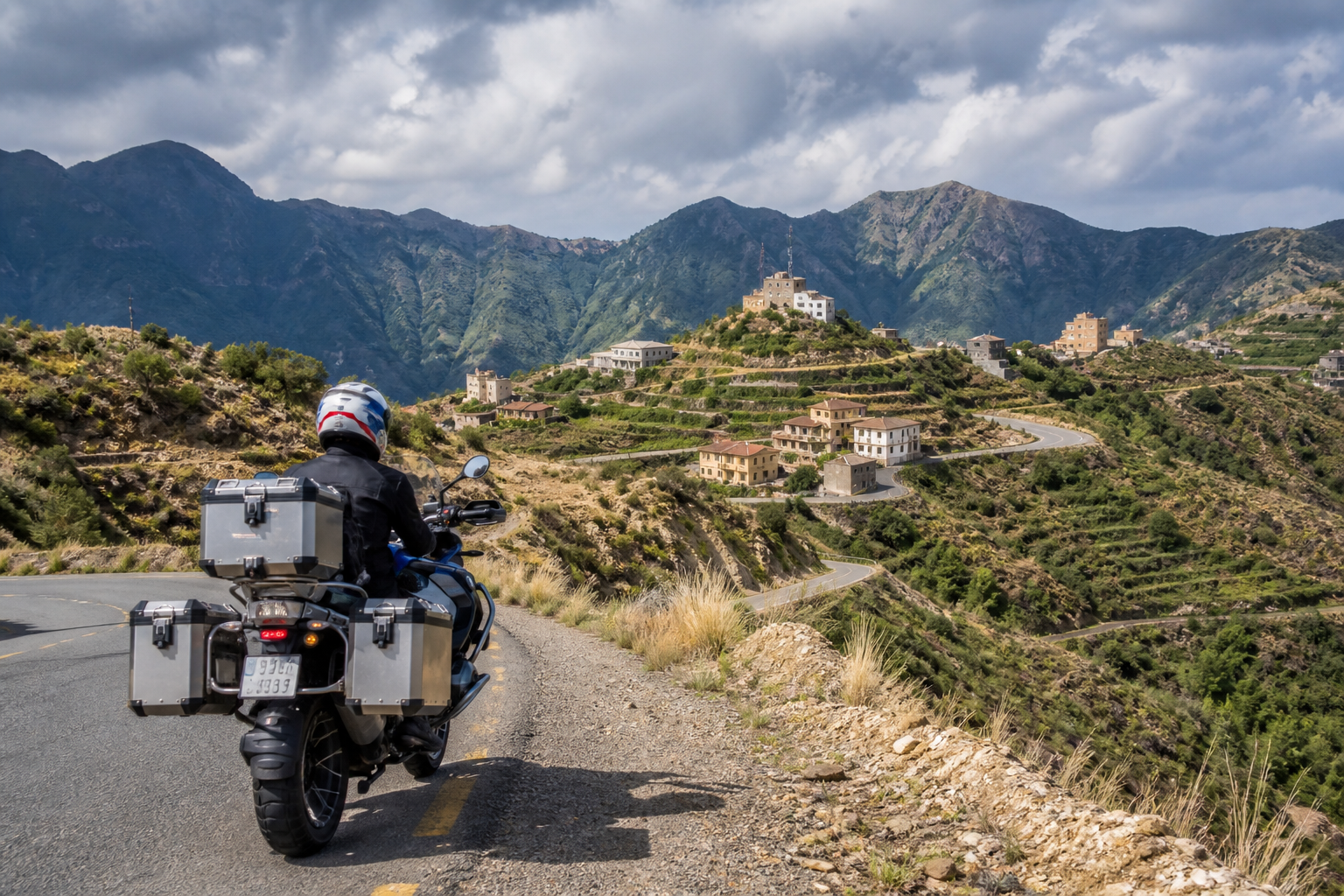
# Riding Through Aseer: My Three-Day Motorcycle Route, Favorite Stops, and Honest Travel Tips
## The Vibe & When to Go
Aseer feels different from the Saudi Arabia many visitors first imagine. Around Abha, the air is cooler, the roads climb through dark green hills, and clouds often drift across the mountains like they have nowhere else to be. One minute you’re looking over a dry valley; the next, you’re riding through mist with juniper trees and old stone villages appearing around a bend.
I joined a three-day motorcycle route through the region, and the best part was the pace. We weren’t rushing from one landmark to another. We stopped for tea, pulled over for wide mountain views, and let the roads do much of the sightseeing.
The highlands are most comfortable from **April to October**, especially compared with Saudi Arabia’s hotter lowland cities. Summer can still bring strong sunshine during the day, but evenings in Abha and the higher mountain areas are often pleasantly cool. Winter mornings can be cold, and fog or rain can make mountain roads slippery.
For a motorcycle trip, I’d choose **late spring, summer, or early autumn**. Leave early each morning, carry a light jacket, and don’t assume the weather will stay the same all day.
## Must-See Spots: My Top Picks
### 1. Abha’s Old Streets and Art-Filled Corners
Abha is the natural starting point, and I liked it more once I stopped treating it only as a base for day trips. The city has a relaxed mountain-town feel, with colorful buildings, small cafés, traditional houses, and a few surprisingly creative public art spaces.
Take a slow ride through the older parts of the city before traffic builds. The **Al-Muftaha Arts Village** is a good place to wander on foot, look at local galleries, and find a quiet coffee stop. I also enjoyed simply sitting near a market and watching families shop for honey, spices, and local handicrafts.
A small piece of advice: don’t plan every meal around restaurants recommended online. Some of my nicest food moments came from modest places serving rice, grilled meat, flatbread, and strong cardamom tea.
### 2. Soudah and the High Mountain Roads
The ride toward **Soudah** was the part I had been looking forward to most, and it delivered. The road climbs into cooler air, with steep drops, thick vegetation in places, and lookout points that make you want to stop every few minutes.
The views are beautiful, but the road deserves respect. Curves can tighten without much warning, and fog sometimes arrives quickly. I kept my speed conservative, especially near blind corners, and avoided riding after dark.
Pack water and a snack because cafés are not guaranteed along every stretch. A roadside stop with a view can easily turn into an hour if you bring tea, a jacket, and no urgent schedule.
### 3. Rijal Almaa Heritage Village
Rijal Almaa is one of the most memorable stops in Aseer. The old stone-and-mud buildings rise against the mountains in a way that feels completely tied to the landscape. The village has a strong sense of place, not just a row of restored façades made for photographs.
Walk slowly through the lanes and look at the details around the windows, doors, and rooflines. The local museum helps explain the village’s trading history and architecture. I found the quieter side paths more interesting than the main photo spots.
Try to arrive before the middle of the day. The light is softer, parking is easier, and you’ll have more time to explore without feeling hurried. Dress respectfully and ask before photographing residents.
### 4. Habala and the Dramatic Valley Views
The old village of **Habala** sits in a steep mountain setting and is usually reached as part of a longer excursion from Abha. Depending on the operating schedule, you may be able to use the cable car, though I would check locally before building the whole day around it.
Even when the cable car is not running, the surrounding viewpoints are impressive. The scale of the cliffs makes the motorcycle ride feel like a proper expedition rather than a quick city outing.
If you visit in warmer months, start early. The sun becomes intense at exposed viewpoints, and there is little shade in some areas.
## A Simple Three-Day Motorcycle Route
**Day 1: Abha and Soudah**
– Collect the motorcycle and check tires, brakes, lights, and fuel
– Explore Abha and Al-Muftaha
– Ride toward Soudah and stop at mountain viewpoints
– Return to Abha or stay near the highlands
**Day 2: Rijal Almaa**
– Leave Abha early
– Follow the mountain roads toward Rijal Almaa
– Spend a few hours walking through the village and visiting the museum
– Stop at roadside viewpoints on the return journey
**Day 3: Habala and nearby mountain roads**
– Ride toward Habala
– Check cable-car operations before setting off
– Take a relaxed route back to Abha, allowing time for cafés and viewpoints
– Return the motorcycle before evening if possible
The route can be shortened or expanded, but I would not try to force every major attraction into three days. Aseer rewards unplanned stops.
## Practical Travel Advice
### Getting There and Visa
Most visitors fly into **Abha International Airport**, usually with a connection through **Riyadh or Jeddah**. Compare flights carefully because a slightly longer connection can be much cheaper. If you’re already in Saudi Arabia, Abha is also reachable by domestic flight from major cities.
Many nationalities can apply for a Saudi tourist **eVisa**, while some travelers may qualify for visa on arrival. GCC citizens generally have simpler entry arrangements. Rules can change, so check the official Visit Saudi or Saudi government visa website before booking.
Your passport should normally have at least **six months of validity** remaining. Keep your accommodation details, return ticket, and travel insurance information accessible at immigration.
For motorcycle rental, bring:
– A valid motorcycle license accepted in Saudi Arabia
– Your passport and visa details
– An international driving permit if your rental company requests one
– A credit card for the deposit
– Travel insurance that covers riding a motorcycle
Motorbike availability in Aseer can be limited compared with larger cities. Booking through a local tour operator or arranging a guided trip in advance is often easier than trying to find a bike after landing.
### Where to Stay
**Abha city center:** Best for first-time visitors, restaurants, cafés, and easy access to supplies. This is where I’d stay for a three-day route.
**Near Soudah:** Better for mountain views, quiet evenings, and cooler temperatures. Accommodation is more limited, so reserve ahead during holidays and summer weekends.
**Around Rijal Almaa:** A good choice if you want a slower heritage experience, though it has fewer dining and shopping options than Abha.
Guesthouses and small hotels can feel more personal, but check parking arrangements if you’re arriving by motorcycle. Secure, covered parking matters more than a fancy lobby.
### Getting Around
Abha is not a highly walkable city, especially if you want to reach viewpoints and villages outside town. Inside central areas, you can walk short distances, but heat, hills, and wide roads make walking less practical than it first appears.
For short rides, **Uber and Careem** are the most useful options, though availability can be thinner at night or outside Abha. Taxis are also common. Google Maps works in the main areas, but I saved offline maps before riding into the mountains.
If you rent a motorcycle:
– Fill up whenever you see a reliable fuel station
– Avoid mountain riding after sunset
– Watch for livestock, loose gravel, and sudden fog
– Carry a physical copy or photo of your rental agreement
– Wear proper protective gear, even when the weather feels mild
## Real Costs and Local Tips
Prices change with the season, but these are realistic daily estimates for one person, **excluding international flights**.
### Budget travel: around 180–280 SAR per day
– Simple hotel or guesthouse: 90–150 SAR
– Local meals and tea: 50–80 SAR
– Short taxi rides and small entrance fees: 30–50 SAR
– Snacks, water, and coffee: 20–30 SAR
### Mid-range travel: around 400–700 SAR per day
– Comfortable hotel: 220–400 SAR
– Restaurants and cafés: 100–180 SAR
– Transport and attractions: 50–100 SAR
A motorcycle rental may add roughly **250–500 SAR per day**, depending on the bike, rental period, insurance, and whether the booking includes a guide or support vehicle. Always ask what the deposit, mileage limit, fuel policy, and damage excess cover.
Saudi Arabia uses the **Saudi riyal (SAR)**. Cards are accepted in most hotels, restaurants, and larger shops, but I still carried cash for small cafés, roadside stalls, and village purchases.
Tipping is not compulsory, though leaving **5–10%** for good restaurant service is appreciated. For cafés, rounding up is perfectly fine.
### A few money-saving tricks
– Eat your main meals at local restaurants rather than hotel dining rooms. Portions are often large enough to share.
– Buy water and snacks in Abha before heading into the mountains, where choices are fewer and prices can rise.
– Ask whether an attraction or cable car is operating before paying for a taxi to get there.
– Book accommodation with parking included; paid parking and last-minute transfers can quietly add to the cost.
– If you buy honey, spices, or crafts, compare two or three stalls first and ask about the price politely.
Aseer is not a destination I’d visit just to collect photographs. The pleasure is in the ride between places: cool air through the helmet, a tea stop beside a mountain road, and the sudden appearance of an old village below you. Give the region enough time to unfold, and the three days will feel much longer than they look on a map.
KEYWORDS: Aseer mountains, Abha Saudi Arabia