
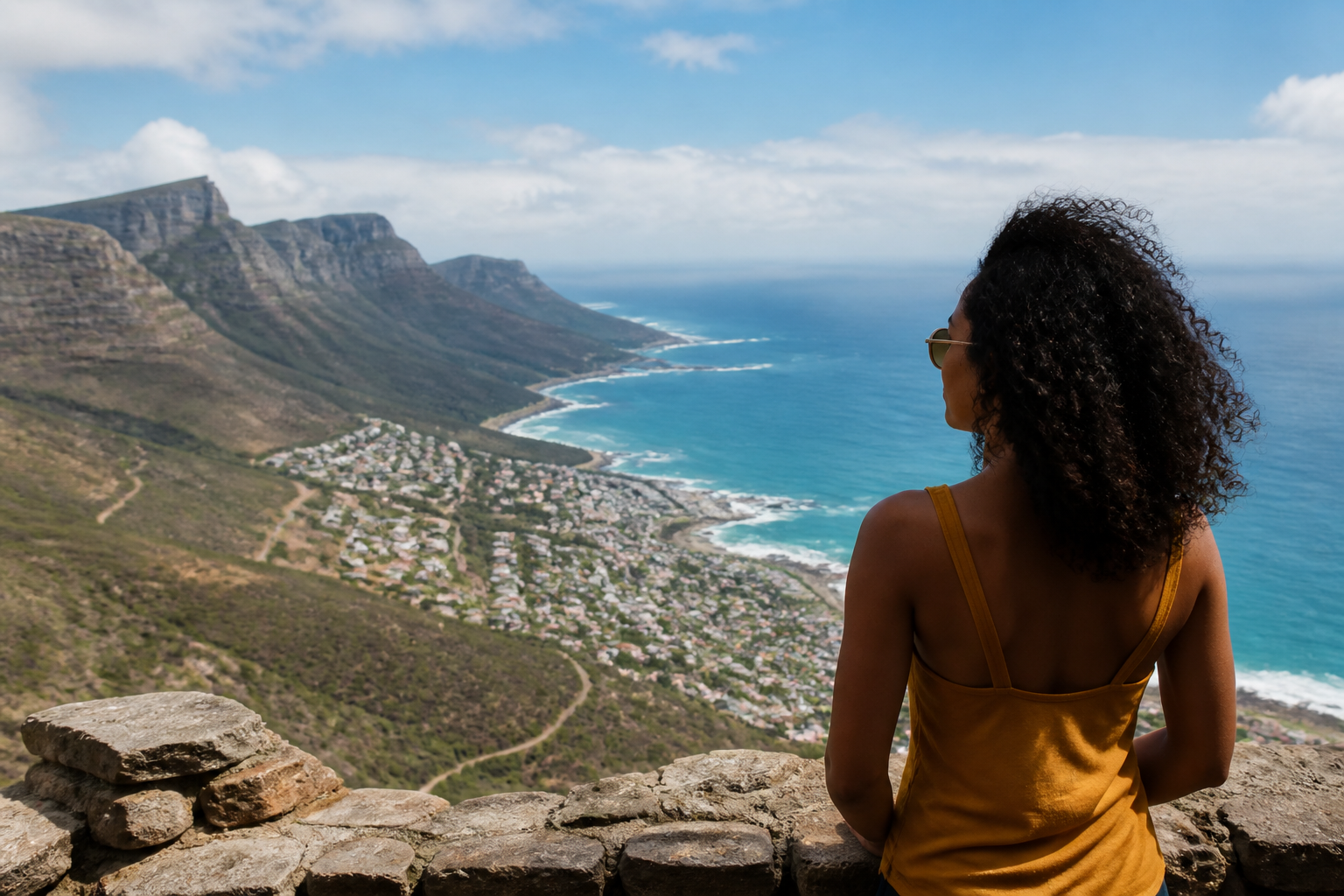
# South Africa After the Slowdown: Cape Town Views, Big Skies, and Honest Travel Tips
South Africa is the kind of place that keeps changing as you move through it. One day you’re drinking excellent coffee in Cape Town, the next you’re watching elephants cross a dusty road in Kruger, and a few days later you’re eating spicy bunny chow in Durban.
The country’s tourism industry has had a difficult few years, but travelers are returning. That matters here. Choosing a locally owned guesthouse, hiring a community guide, or eating at a family-run restaurant puts money directly into the places and people making South Africa special.
## The Vibe & When to Go
South Africa feels big, open, varied, and a little unpredictable in the best way. Cape Town has a creative, outdoorsy energy. Johannesburg is fast, layered, and full of people with stories to tell. The coast is slower, warmer, and more relaxed, while the national parks bring a quiet that you feel in your chest.
The country is in the **Southern Hemisphere**, so the seasons are opposite to Europe and North America:
– **March to May:** Mild autumn weather, fewer crowds, and some of the best conditions for city breaks and road trips.
– **June to August:** Cooler and drier inland, which is excellent for wildlife viewing. Cape Town can be wet and windy.
– **September to November:** Spring brings green landscapes, flowers, and comfortable temperatures.
– **December to February:** Warm summer weather, especially along the coast, though Cape Town and popular beaches can be busy and more expensive.
If you’re planning a trip soon, check the forecast by region rather than relying on a national average. Johannesburg can be sunny and cool while Durban is humid and beach-perfect on the same day.
## Must-See Spots: My Top Picks
### 1. Cape Town Beyond the Postcard Views
Table Mountain is unforgettable, but I enjoyed Cape Town most when I slowed down around it. Take the cable car early if the weather is clear, then spend time walking through the Company’s Garden and the colorful streets of Bo-Kaap.
For a quieter afternoon, head to **Kalk Bay**. Browse the small shops, eat fish and chips near the harbor, and walk toward St James if the weather is good. The tidal pools around St James and Muizenberg are lovely for a swim, though always pay attention to local safety advice.
I also recommend driving the **Cape Peninsula** if you have a full day. Stop at Hout Bay, Chapman’s Peak, Noordhoek, Cape Point, and Boulders Beach. Start early, especially in summer, because the roads fill up quickly.
**My tip:** Don’t force a Table Mountain visit if the summit is covered in cloud. The weather can change quickly, and Signal Hill or Lion’s Head may offer a better view that day.
### 2. Johannesburg for Food, History, and Local Stories
Johannesburg is often treated as a short stop between flights, which is a shame. It can feel intense at first, but spend a little time with a good local guide and the city opens up.
Visit the **Apartheid Museum**, then explore **Soweto** with a guide who can explain the neighborhoods beyond the usual landmarks. Vilakazi Street is famous for its connection to Nelson Mandela and Desmond Tutu, but the best moments often come from conversations, street food, and seeing everyday life beyond the tour route.
For food and culture, I like **Maboneng** and **Braamfontein**, though the atmosphere can change from street to street. Go during daylight, use a rideshare between stops, and avoid wandering around unfamiliar areas with your phone out.
**My tip:** Book a walking, cycling, or food tour led by someone who lives in the city. It gives you context that a museum label can’t provide, and it supports local businesses.
### 3. Kruger National Park for the Quiet Moments
Kruger is famous for the Big Five, but my favorite memories were smaller: a troop of baboons grooming each other, a lone giraffe disappearing behind acacia trees, and the silence after sunset.
You can visit with a private safari company, stay in a lodge, or drive yourself between rest camps. Self-driving is more affordable and gives you freedom, but you’ll need patience. The animals don’t follow a schedule, and the most rewarding sightings may come after an hour of seeing nothing at all.
The southern section is easier for a first visit and has a good range of accommodation. The northern areas are quieter and more remote.
**My tip:** Don’t crowd an animal sighting. If several vehicles are blocking the road, move on and return later. You’ll have a better experience and won’t add to the stress around the animals.
### 4. The Garden Route for a Slower Road Trip
The Garden Route is a great choice if you want beaches, forests, small towns, and plenty of stops along the way. A typical route might include **Mossel Bay, Wilderness, Knysna, Plettenberg Bay, and Tsitsikamma**.
I loved the forest walks around Tsitsikamma and the calm lagoons near Wilderness. Plettenberg Bay has beautiful beaches, while Knysna is good for oysters, boat trips, and a relaxed overnight stop.
Give yourself at least four or five days. Trying to race through the entire route makes it feel like a long drive rather than a holiday.
**My tip:** Add time for unexpected stops. South Africa’s smaller farm stalls often serve better breakfasts and homemade treats than the restaurants you planned in advance.
## Practical Travel Advice
### Getting There & Visa
Most international visitors fly into **O.R. Tambo International Airport in Johannesburg** or **Cape Town International Airport**. Durban’s King Shaka International Airport is useful if you’re focusing on KwaZulu-Natal or the eastern coast.
For flights:
– Compare Johannesburg and Cape Town rather than assuming one will be cheaper.
– If you’re visiting several regions, check the cost of an open-jaw ticket: fly into Johannesburg and home from Cape Town, or the reverse.
– Domestic flights are often the easiest way to connect Johannesburg, Cape Town, Durban, and Kruger-area airports.
– Leave plenty of time between international and domestic flights, especially at Johannesburg.
Visa rules depend on your passport and the length and purpose of your visit. Many travelers from Europe, the United States, Canada, Australia, and several other countries can enter for short stays without arranging a visa in advance, but the permitted stay varies. Other nationalities need to apply before traveling.
Check the latest rules with the **South African Department of Home Affairs or your nearest South African mission** before booking. Your passport should have blank pages and enough validity for the required period. If you’re traveling with children, check the current document requirements carefully, as extra paperwork may apply.
### Where to Stay
**Cape Town:**
Stay in the City Bowl for restaurants and easy access to Table Mountain. De Waterkant is lively and convenient. Sea Point works well for ocean walks, while Camps Bay is beautiful but usually pricier.
**Johannesburg:**
Rosebank and Melrose are practical choices with hotels, restaurants, and shopping nearby. Maboneng is better for a creative city feel, but check the exact location and transport arrangements before booking.
**Durban:**
Umhlanga is polished and easy for beach time. The central beachfront can be lively, while quieter guesthouses are found farther north and south.
**Kruger:**
National park rest camps are convenient for self-drivers. Private reserves offer a more intimate safari experience, but prices rise quickly. Staying just outside the park can save money, though you’ll need to plan entry times.
**Garden Route:**
Wilderness is peaceful and nature-focused. Knysna is convenient for restaurants and boat trips. Plettenberg Bay is best for beaches and a little more nightlife.
### Getting Around
South Africa is not uniformly walkable, and distances are larger than they look on a map.
– Use **Uber or Bolt** in major cities, but confirm the car, driver, and pickup point before getting in.
– The **Gautrain** is useful between Johannesburg’s airport, Sandton, Rosebank, and Pretoria.
– Cape Town’s **MyCiTi buses** are handy in selected areas, though they won’t take you everywhere.
– Renting a car is ideal for the Garden Route, Winelands, parts of the coast, and self-driving in Kruger.
– Avoid driving long distances after dark, especially in unfamiliar areas.
– Keep bags out of sight in the car and ask your accommodation about safe parking and local routes.
For city sightseeing, I prefer using rideshare apps between neighborhoods instead of walking long distances without knowing the area. In smaller towns and scenic regions, walking is usually much easier.
## Real Costs & Local Tips
South Africa uses the **South African rand (ZAR)**. Prices vary a lot between Cape Town’s busiest areas, private safari lodges, and smaller towns.
### Approximate Daily Budgets
**Budget traveler: R900–R1,500 per person**
– Dorm bed or simple guesthouse: R300–R650
– Local breakfast or takeaway: R70–R150
– Casual lunch: R100–R180
– Dinner at an inexpensive restaurant: R150–R300
– Local transport: R100–R250
**Mid-range traveler: R2,000–R3,800 per person**
– Comfortable hotel or private guesthouse: R900–R1,800
– Coffee and breakfast: R150–R250
– Sit-down lunch: R180–R300
– Dinner with drinks: R350–R700
– Rideshares, activities, and entry fees: R300–R800
Safari lodges, guided excursions, wine tours, and car hire can push the daily total much higher. A Kruger self-drive trip is far cheaper than staying at a luxury private reserve.
### Tipping Etiquette
Tipping is common and appreciated. Around **10–15%** is normal at restaurants if service isn’t already included. You can tip hotel porters, private guides, drivers, and safari staff according to the quality of service and the length of your stay. Keep small notes handy for parking attendants and petrol-station staff who assist with fueling and windows.
### A Few Ways to Save Money
– **Eat where locals eat.** Look for busy cafés, neighborhood grills, food markets, and small family-run restaurants rather than ordering every meal in a tourist district.
– **Book popular sights early.** Table Mountain, safari lodges, and long-distance car rentals can become expensive during school holidays and December.
– **Use a local SIM or eSIM.** Reliable data makes rideshares, maps, and travel updates much easier.
– **Don’t exchange all your money at the airport.** Use a reputable ATM or card-friendly provider, and let your bank handle the currency conversion when possible.
– **Ask about safety before exploring on foot.** A hotel receptionist, café owner, or local guide can usually tell you which streets to use and when.
– **Support smaller operators.** Community tours, independent guesthouses, and locally owned restaurants often offer better experiences than large chains while keeping more money in the local economy.
South Africa doesn’t need to be treated like a perfect postcard. It is a country with beauty, inequality, warmth, complicated history, and plenty of places still rebuilding after a difficult period for tourism. Travel with curiosity, spend thoughtfully, and give yourself enough time to look beyond the headline attractions. That’s when the country starts to feel less like a checklist and more like a real place.
KEYWORDS: South Africa landscape