
# India Beyond the Big Names: Quiet Places, Local Flavors, and Real Travel Tips
India’s famous cities are unforgettable, but some of my best travel memories came from places that rarely appear on a first-time itinerary. That is the spirit behind the Tourism Ministry’s new **Digital Tourism Stack** and its wider mission to bring lesser-known destinations into the spotlight—not by turning them into theme parks, but by making them easier to discover and visit.
I’ve put together a route through four very different corners of India: **Orchha in Madhya Pradesh, Majuli in Assam, Tirthan Valley in Himachal Pradesh, and Lakshadweep**. You could visit one slowly or build a longer trip around two or three.
## The Vibe & When to Go
India doesn’t have one travel season. The weather changes dramatically from the Himalayas to the southern islands.
– **Orchha:** Best from October to March, when the days are sunny and comfortable. April and May can be intensely hot.
– **Majuli:** Visit from October to April. Winter is pleasant, while the monsoon can affect ferry services and flood low-lying areas.
– **Tirthan Valley:** May to June is lovely for walks and cool evenings. September to November brings clear mountain views. Winter is peaceful but cold.
– **Lakshadweep:** October to May usually offers the best conditions for beaches and boat trips. Monsoon travel can be unpredictable.
The overall feeling is slower and more personal than in Delhi, Mumbai, or Jaipur. You’ll see fewer big tour groups, but you may also find fewer ATMs, patchier phone service, and limited public transport. That trade-off is part of the charm—and something to plan for.
## Must-See Spots: My Top Picks
### 1. Orchha, Madhya Pradesh: Temples, River Views, and Empty Streets
Orchha feels like a forgotten royal town, especially early in the morning when the streets are quiet and the Bundela-era buildings glow in the soft light.
The **Orchha Fort complex** is the obvious starting point. I liked wandering without rushing between the palaces and courtyards, looking at the faded wall paintings and stone details. The **Jahangir Mahal** has the best views, while the **Ram Raja Temple** is unusual because the deity is worshipped as a king.
My favorite moment was walking down to the **Betwa River** near sunset. The stone cenotaphs across the water make a beautiful view, and the riverbank is far calmer than the fort area.
**Try this:**
– Visit the fort before 9 a.m. to avoid heat and crowds.
– Hire a local guide for an hour if you want the history to make sense.
– Stay at least two nights; Orchha is too easily treated as a quick stop from nearby Khajuraho.
– Try a simple thali at a family-run restaurant rather than eating every meal at a hotel.
### 2. Majuli, Assam: Island Life and Bamboo Houses
Majuli is one of those places where plans tend to soften. The days revolve around ferries, bicycles, rice fields, village paths, and long cups of tea.
The island is known for its **satras**, or Vaishnavite monasteries. I enjoyed visiting **Auniati Satra** and **Kamalabari Satra**, but the quieter pleasure was cycling between villages and stopping whenever someone invited me to see a weaving setup or taste homemade food.
You may see traditional mask-making in **Samaguri Satra**, where artisans create colorful masks for Assamese performances. The craft is fascinating, but it is better to ask before taking close-up photographs.
**Try this:**
– Rent a bicycle or hire a local tuk-tuk driver for the day.
– Eat Assamese dishes such as rice, dal, tenga fish curry, and seasonal greens.
– Carry cash, sunscreen, mosquito repellent, and a power bank.
– Keep your schedule flexible. Ferry timings and weather can change your plans.
### 3. Tirthan Valley, Himachal Pradesh: Forest Trails and Quiet Evenings
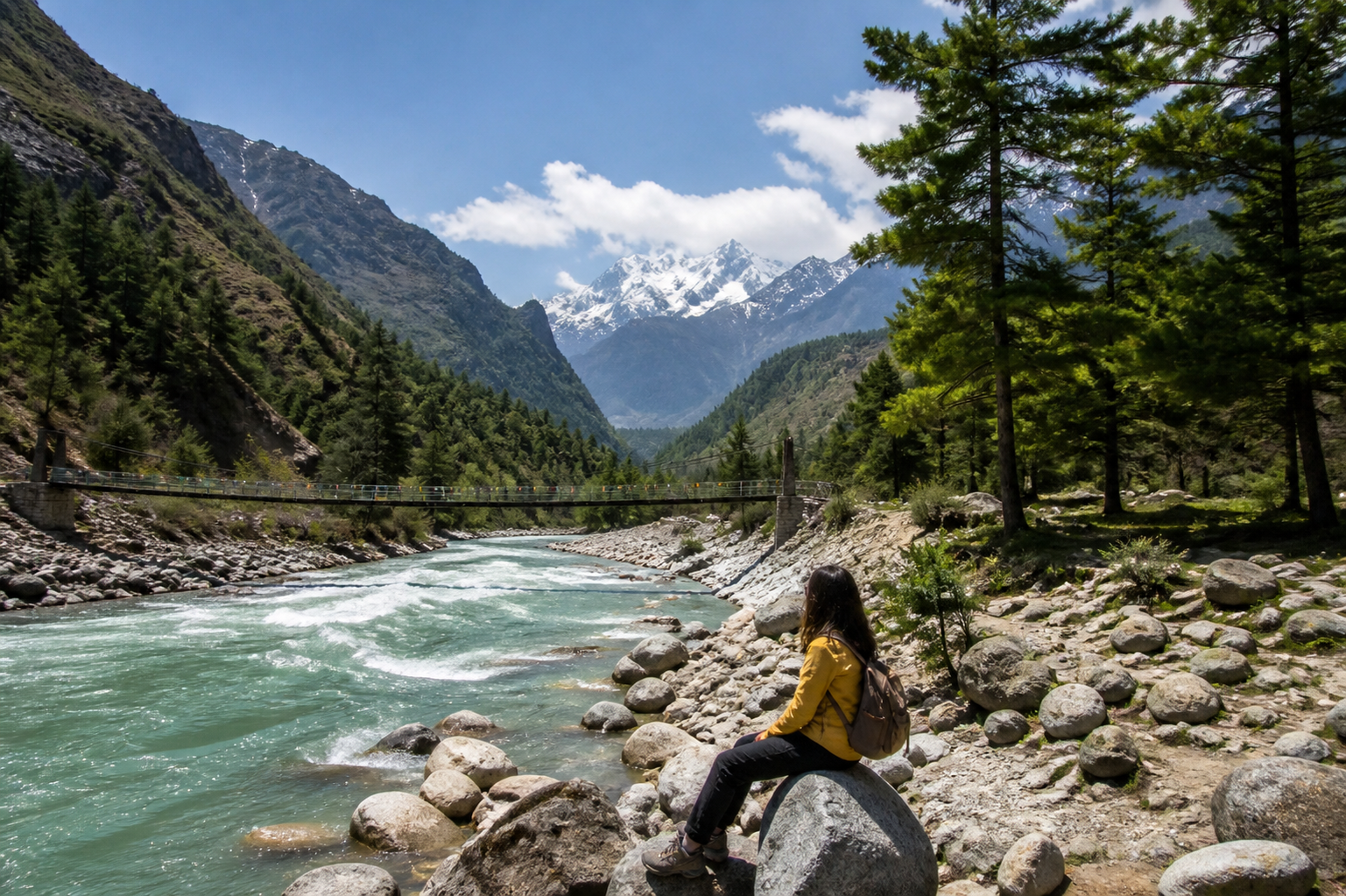
Tirthan Valley suits travelers who want mountain scenery without the busy café culture of Manali. The villages are spread along the river, with pine forests, wooden homes, and small guesthouses that serve warm meals.
The **Great Himalayan National Park** is the main attraction. You’ll need a local guide for many trails, and the walks can range from gentle forest paths to demanding multi-day hikes. I preferred taking a shorter walk, then spending the afternoon beside the river with a book.
**Jibhi Waterfall** is easy to reach but can become busy during holidays. Go early, or walk farther into the surrounding lanes for a quieter view. **Jalori Pass** is another good day trip when the road is open.
**Try this:**
– Stay in **Gushaini** for easier access to the national park.
– Choose **Jibhi** if you want cafés, cottages, and a livelier backpacker feel.
– Carry a light jacket even in summer; evenings turn cool quickly.
– Don’t depend entirely on online maps—some walking trails are poorly marked.
### 4. Lakshadweep: Clear Water Without the Crowds
Lakshadweep requires more planning than a typical beach holiday, but the reward is beautiful water, coral reefs, and a much quieter atmosphere than many mainland resorts.
**Agatti** is the easiest island for many visitors because it has the main airport. **Bangaram** is known for its beaches and snorkeling, while **Kavaratti** offers a more local island experience and a chance to learn about everyday life in the archipelago.
The sea is the main event here. I’d plan at least one snorkeling trip, but I’d also leave time to do absolutely nothing. The islands are best enjoyed slowly, without trying to pack several activities into each day.
**Try this:**
– Book permits and accommodation well in advance.
– Check which islands are open to visitors before planning your route.
– Use reef-safe sunscreen and avoid stepping on coral.
– Follow local guidance about clothing, alcohol, photography, and swimming areas.
## Practical Travel Advice
### Getting There & Visa
For international visitors, India generally requires a visa before arrival. Many nationalities can apply online for an **e-Visa**, but the eligible countries, fees, passport rules, and permitted airports can change. Apply through the official Indian government visa website rather than through a random agency offering “express” services.
You’ll usually need:
– A passport with sufficient validity and blank pages
– A recent digital photograph
– A scan of the passport information page
– Proof of onward or return travel in some cases
– Accommodation details
For the destinations above:
– **Orchha:** Fly to Delhi, Gwalior, or Khajuraho, then continue by train, taxi, or bus.
– **Majuli:** Fly to Jorhat, travel to Nimati Ghat, and take the public ferry.
– **Tirthan Valley:** Travel by road from Chandigarh, Delhi, or Bhuntar Airport.
– **Lakshadweep:** Fly to Agatti or join an approved package that includes permits and transfers.
For domestic flights, I usually compare prices on Indian booking sites and check baggage rules carefully. Smaller airlines and regional routes can have limited schedules, so avoid booking a tight same-day connection.
### Where to Stay
India’s lesser-known destinations rarely have formal “neighborhoods,” but choosing the right base still makes a difference.
– **Orchha:** Stay near the fort for walkability, or across the river for a quieter guesthouse setting.
– **Majuli:** Choose a village homestay if you want local interaction. Kamalabari is convenient for exploring the island.
– **Tirthan Valley:** Gushaini is best for nature and park access; Jibhi has more cafés and independent guesthouses.
– **Lakshadweep:** Pick the island based on your permit and resort availability rather than trying to move around too much.
Homestays are often the most memorable option. Ask whether meals, hot water, Wi-Fi, and transport are included before confirming.
### Getting Around
Public transport is affordable but not always frequent.
– Trains are useful for reaching central India and larger towns.
– Buses connect many mountain and rural areas, though journeys can be slow.
– Auto-rickshaws and local taxis are common in smaller towns.
– Uber and Ola work well in many major Indian cities, but usually not in remote destinations.
– In villages and on islands, arrange transport through your guesthouse.
– Download offline maps and keep the address of your accommodation written in English and the local script if possible.
On mountain roads, allow more time than the distance suggests. A 100-kilometer journey may take four or five hours.
## Real Costs & Local Tips
The Indian rupee is the local currency. Prices vary widely, but these are realistic daily estimates per person, excluding international flights.
### Budget travel: ₹1,500–₹3,000 per day
This usually covers:
– Basic guesthouse or hostel bed
– Local buses and shared rides
– Street food and simple restaurants
– One low-cost activity
### Mid-range travel: ₹4,000–₹8,000 per day
This usually covers:
– Comfortable private room or homestay
– Restaurant meals
– Local taxis for part of the day
– A guide, entry fees, or one organized excursion
Lakshadweep can cost considerably more because permits, boats, meals, and accommodation are often bundled into packages.
Tipping is not compulsory, but rounding up or leaving around **5–10%** in a good restaurant is appreciated. For guides and drivers, a separate tip is appropriate if they have been helpful.
### A Few Tricks That Saved Me Money
– **Carry cash in smaller notes.** Rural shops, ferries, and small cafés may not accept cards or digital payments.
– **Use UPI when available.** It is widely used in India, though visitors may need a local setup or an international payment service that supports it.
– **Ask for the local price before getting into an auto-rickshaw.** If there is no meter, agree on the fare first.
– **Eat where local families eat.** Busy, modest restaurants are often cheaper and more reliable than places with large tourist menus.
– **Book island permits and mountain transport early.** Last-minute arrangements can be expensive or impossible.
– **Keep a buffer day.** Ferries, mountain roads, and regional flights do not always run exactly as planned.
The new Digital Tourism Stack may make it easier to discover places like these, but the best experiences still come from slowing down, speaking with local people, and accepting that rural travel can be a little untidy. That is exactly why I’d choose these destinations over another rushed checklist trip.
KEYWORDS: India countryside