
# Exploring Taiwan: Night Markets, Mountain Tea, and the Easy Way to Plan Your Trip
Taiwan’s largest listed travel company, **Lion Travel Service**, is set to exhibit for the first time at **Tourism EXPO Japan 2026** through its Japanese subsidiary, **Lion Travel Japan**. That caught my attention because Taiwan is the kind of place I’m always happy to recommend to friends: easy to get around, generous with food, and full of small surprises once you leave the main streets.
If you’re thinking about visiting Taiwan, this is my honest starter guide—where I’d go, what I’d eat, how much I’d budget, and the little things that made my own trips smoother.
## The Vibe & When to Go
Taiwan feels lively without being exhausting. Taipei has the energy of a big Asian city—bright signs, scooter traffic, busy train stations—but it also has quiet tea houses, riverside paths, leafy parks, and hot springs just a short ride away.
The weather changes a lot by season:
– **Spring, March to May:** Warm and comfortable, though rain showers are common.
– **Summer, June to August:** Hot, humid, and rainy, with a chance of typhoons. Bring light clothes and plan indoor breaks.
– **Autumn, September to November:** Often the most pleasant time, with cooler days and good conditions for hiking.
– **Winter, December to February:** Mild in Taipei, but damp and surprisingly chilly. Southern Taiwan is usually warmer.
I especially like visiting in **late autumn or spring**, when walking around neighborhoods and night markets doesn’t leave me completely overheated. The Tourism EXPO Japan 2026 appearance should also make it easier for Japanese travelers to discover Lion Travel Japan’s Taiwan tours, transport options, and regional itineraries in one place.
## Must-See Spots: My Top Picks
### 1. Taipei 101 and the streets of Xinyi
Taipei 101 is the obvious landmark, but I enjoy the area more when I don’t rush straight to the observatory. The surrounding Xinyi district has wide sidewalks, shopping malls, cafés, and open plazas where you can see the tower from different angles.
Go near sunset if the weather is clear. After taking in the view, walk toward **Elephant Mountain** for a city panorama. The climb is short but steep, and the stone steps can be slippery after rain. I’d bring water and wear proper shoes rather than treating it like a casual stroll.
For a quieter view of Taipei 101, try the trails around **Fuzhoushan Park**. You’ll see fewer visitors and get a more local evening atmosphere.
### 2. Longshan Temple and Wanhua
Longshan Temple is one of the places I return to because it feels lived-in, not staged for visitors. People come to pray, light incense, and consult fortune tellers, while the surrounding streets carry on with their ordinary rhythm.
Visit respectfully, especially during ceremonies. Afterward, wander through **Bopiliao Historical Block** and the older lanes of Wanhua. You’ll find traditional shops, herbal stores, small eateries, and plenty of photo opportunities without having to chase famous viewpoints.
A bowl of beef noodle soup or a simple pork rice dish nearby makes a satisfying lunch. The best meals here are often modest-looking and busy with local customers.
### 3. Jiufen and the northeast coast
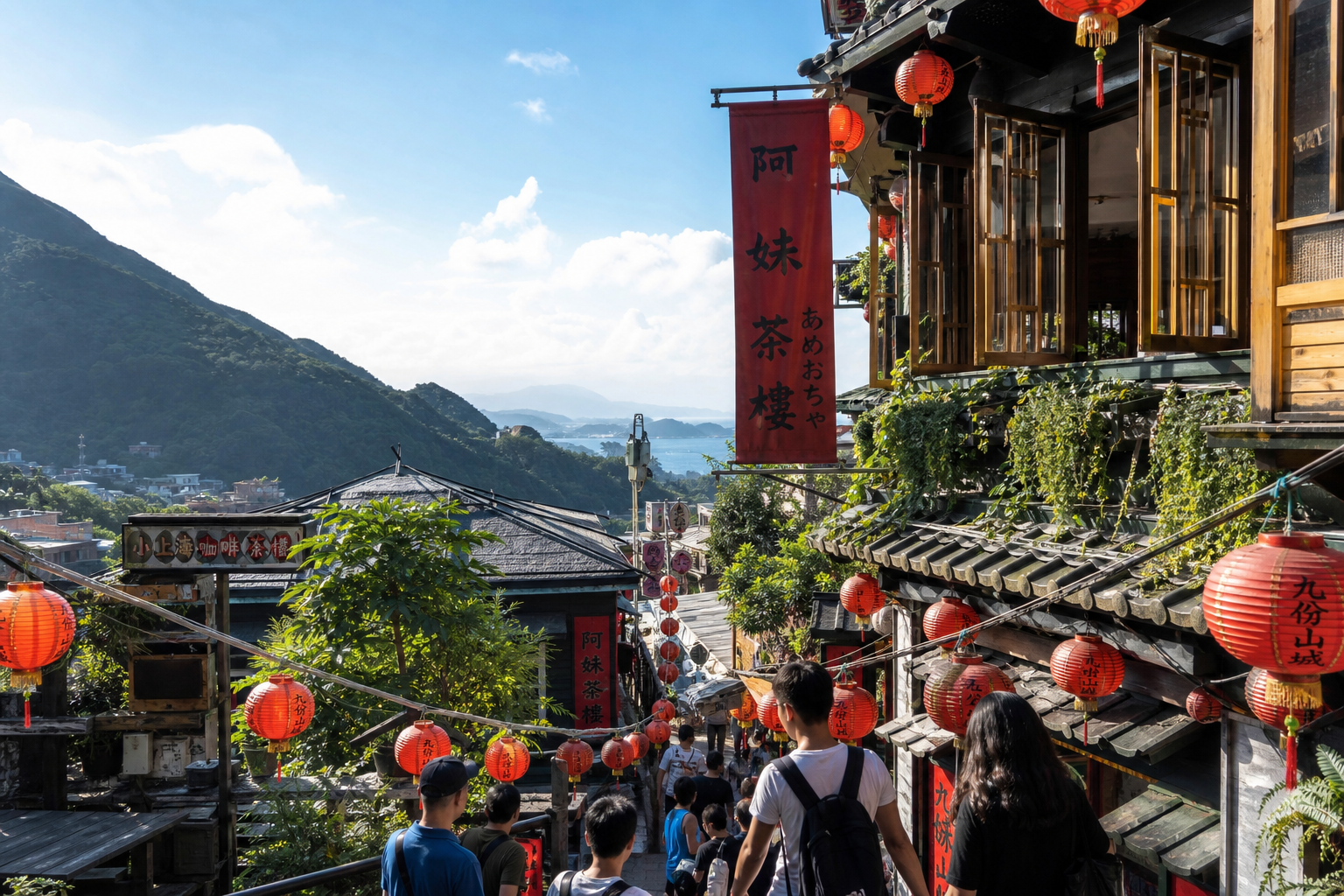
Jiufen’s narrow lanes, tea houses, and hillside views make it a popular day trip from Taipei. I recommend arriving before late morning, especially on weekends, because the main streets become crowded quickly.
Don’t spend the whole visit on the busiest snack lane. Walk beyond the central market, sit down for tea, and follow the quieter side paths. The weather can change quickly, so pack a light rain jacket even when Taipei is sunny.
If you have more time, combine Jiufen with **Shuinandong** or the coast around **Jinguashi**. The mountain-and-sea scenery is beautiful, and the old mining history gives the area more depth than a quick photo stop.
### 4. Tainan for food and slower streets
Tainan is where I’d send anyone who plans a second Taiwan trip. It’s Taiwan’s old capital and one of the best places to eat your way through a city.
Try:
– Beef soup for breakfast
– Danzai noodles
– Milkfish or grilled seafood
– Coffin bread, if you’re curious about local street snacks
– Traditional shaved ice in the afternoon
The **Anping** area has historic streets and old forts, while central Tainan is better for temples, snack shops, and small cafés. The city is less polished than Taipei in places, which is part of its charm. Rent a bicycle or use short taxi rides between food stops, since some sights are spread out.
## Practical Travel Advice
### Getting There and Visa
Taiwan’s main international gateway is **Taoyuan International Airport**, outside Taipei. From the airport, the Airport MRT reaches Taipei Main Station in roughly 35 to 50 minutes, depending on the train.
There are direct flights to Taiwan from many Japanese cities, as well as major airports across Asia, North America, and Europe. For better fares, I usually compare flights arriving at Taoyuan with flights to **Kaohsiung International Airport**, especially if my trip focuses on southern Taiwan.
Visa rules depend on your passport. Many travelers, including citizens of Japan and several other countries, can enter Taiwan visa-free for short tourist stays, but the permitted length and conditions vary. Check the latest information from Taiwan’s official immigration or representative office before booking. Your passport should generally be valid for the required period, and immigration may ask for an onward or return ticket.
### Where to Stay
– **Taipei Main Station:** Best for first-time visitors, train connections, and day trips.
– **Ximen:** Lively, youthful, and convenient for shopping, food, and late-night wandering.
– **Zhongshan:** A calmer choice with cafés, small boutiques, and good restaurants.
– **Da’an:** More residential and comfortable, with parks and easy MRT access.
– **Near Songshan:** Handy for night-market food and a more local city feel.
– **Tainan city center:** Ideal for food-focused trips and historic neighborhoods.
– **Kaohsiung near Formosa Boulevard:** Good for metro access, markets, and a more relaxed pace.
I prefer staying near an MRT station rather than choosing a hotel solely for its view. A five-minute walk to transit saves a surprising amount of energy.
### Getting Around
Taipei is easy to navigate using the **MRT**, buses, and walking. Buy an **EasyCard** when you arrive; it works on public transport and can also be used at many convenience stores.
For longer journeys, Taiwan’s high-speed rail links Taipei, Taichung, Tainan, and Kaohsiung. Local trains are useful for smaller cities and coastal areas.
Taxis are common and reasonably practical for short rides. **Uber** operates in Taiwan, while local taxi apps are also available. In cities such as Taipei and Kaohsiung, you can often use public bike-share systems for short trips, although I’d avoid cycling on unfamiliar roads during heavy traffic.
## Real Costs and Local Tips
Taiwan is not as cheap as it once was, but it remains manageable for travelers who eat locally and use public transport.
### Approximate daily budgets
**Budget traveler: NT$1,500–2,500 per day**
– Hostel bed or simple guesthouse
– Night-market meals and convenience-store breakfasts
– MRT, buses, and occasional short train rides
– Free temples, parks, markets, and city walks
**Mid-range traveler: NT$3,500–6,500 per day**
– Comfortable hotel room
– Restaurant meals mixed with street food
– MRT, taxis, and occasional intercity trains
– Paid attractions, cafés, and day trips
Accommodation can push these figures higher in Taipei during holidays, weekends, and major events.
Taiwan uses the **New Taiwan dollar (NT$ or TWD)**. Credit cards are accepted at many hotels, shopping centers, and modern restaurants, but cash is still useful for markets, small eateries, and taxis. ATMs are easy to find, especially at convenience stores and metro stations.
Tipping is generally not expected at casual restaurants. Some hotels and higher-end restaurants may add a service charge, usually shown clearly on the bill.
### A few local tricks that saved me money
– **Use convenience stores as travel backup.** FamilyMart and 7-Eleven have decent snacks, drinks, ATMs, parcel services, and sometimes surprisingly good hot meals.
– **Eat where there’s a queue—but check what kind of queue it is.** A line of locals is encouraging, while a line created mainly by social media photos may not mean the food is exceptional.
– **Avoid changing all your money at the airport.** Exchange a small amount on arrival, then compare rates at banks or reputable city exchange counters.
– **Book popular trains and hotels early around holidays.** Lunar New Year, long weekends, and summer travel periods can fill up quickly.
– **Carry tissues and hand sanitizer.** Many traditional food stalls and older public restrooms are wonderfully practical but not always fully stocked.
– **Don’t overpack your itinerary.** Taiwan’s cities reward wandering. Leave an afternoon open for a temple, tea shop, market, or neighborhood you didn’t see in your guidebook.
Lion Travel Service’s appearance at Tourism EXPO Japan 2026 may be especially useful for travelers who prefer organized planning, Japanese-language support, or a packaged route covering several parts of Taiwan. Even if you usually travel independently, I’d still use the event as a chance to compare regional ideas—Taipei is only the beginning, and places like Tainan, Hualien, Sun Moon Lake, and Kaohsiung can give the trip a very different character.
KEYWORDS: Taiwan Taipei