
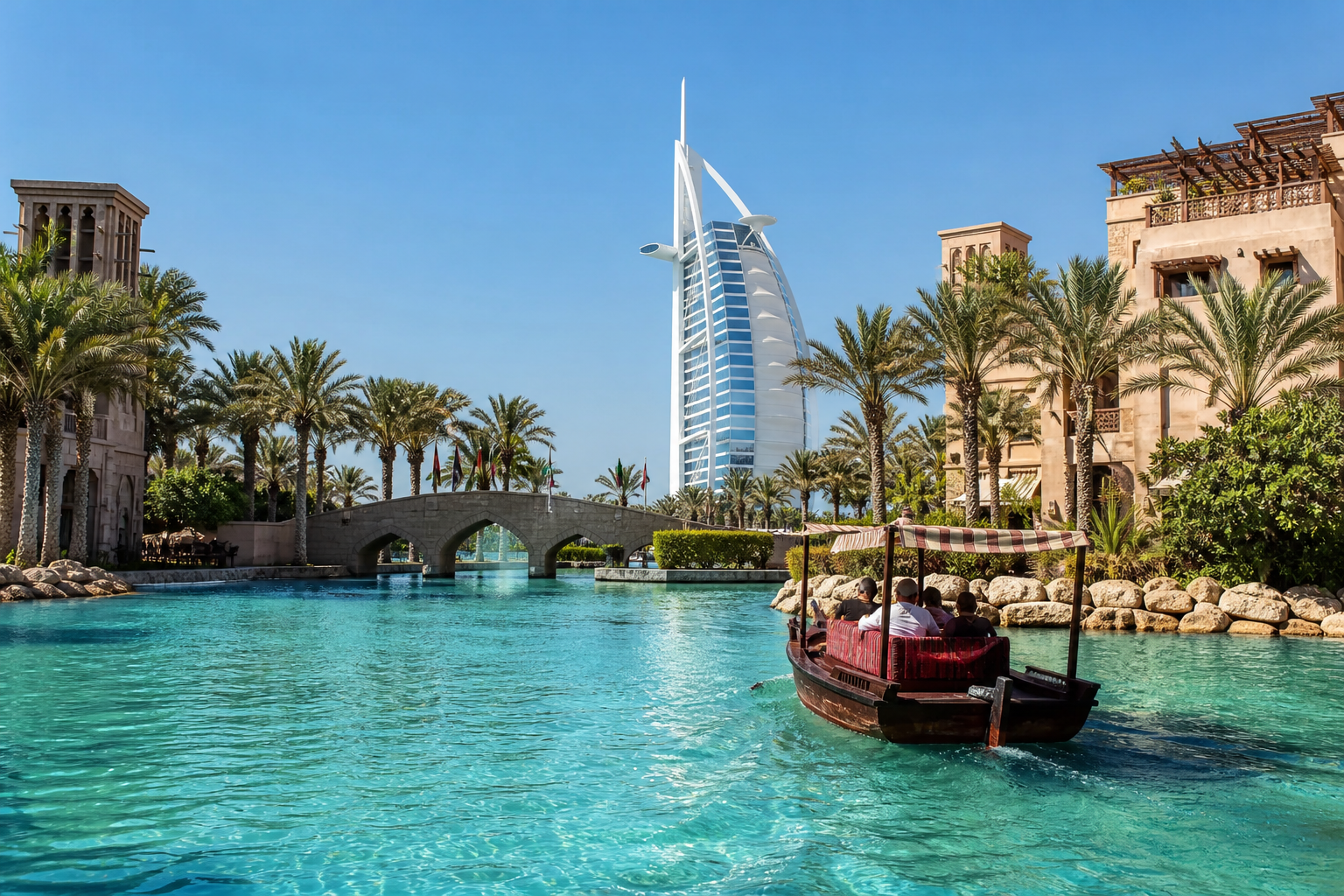
# Dubai Beyond the Skyline: My Favorite Places, Local Food, and Honest Budget Tips
Dubai is having another busy moment. With **Arabian Travel Market (ATM) 2026** bringing the travel industry back to Dubai World Trade Centre, the city is welcoming its highest monthly visitor numbers since February. You can feel the extra energy in the airport, hotels, restaurants, and shopping areas—but Dubai still has quieter corners if you know where to look.
I enjoy Dubai most when I balance the famous sights with old neighborhoods, inexpensive cafés, and time near the water. The city can feel polished and futuristic one minute, then wonderfully ordinary the next.
## The Vibe & When to Go
If you’re visiting around ATM 2026 in May, prepare for real heat. Days are usually hot and sunny, and the afternoon can feel too intense for long outdoor walks. Evenings are more comfortable, especially near the beach or Creek. Hotels, malls, taxis, and restaurants are heavily air-conditioned, so I always carry a light layer.
Dubai’s cooler months, from **November to March**, are the easiest for sightseeing. December through February brings the most pleasant outdoor weather, though prices rise and popular attractions book up quickly. April and May can still be enjoyable if you plan sightseeing early in the morning and after sunset.
Right now, Dubai is particularly lively because of the visitor surge and ATM. There are new hotel openings, restaurant promotions, industry events, and plenty of international travelers around. Just don’t mistake the buzz for a reason to rush. Dubai is much more enjoyable when you leave space between attractions.
## Must-See Spots: My Top Picks
### 1. Al Fahidi Historical Neighbourhood and Dubai Creek
I always suggest beginning in old Dubai rather than at the tallest tower. The narrow lanes around Al Fahidi are calm, shaded, and full of wind towers, courtyards, small galleries, and cafés. It gives you a better sense of the city before the skyscrapers took over the view.
From there, walk toward Dubai Creek and take an abra boat to Deira. The ride is short and inexpensive, but it’s one of my favorite experiences in the city. Sit near the edge, watch the wooden boats move across the water, and forget about your phone for ten minutes.
After crossing, wander through the spice and gold souks. The souks are busy and tourist-friendly, so compare prices before buying. A little friendly bargaining is normal, especially for souvenirs and spices.
**My tip:** Visit early in the morning or after 5 p.m. The midday heat makes the old streets much less pleasant.
### 2. Burj Khalifa and Downtown Dubai
The Burj Khalifa is touristy, but I still think the view is worth seeing at least once. From the observation decks, Dubai looks almost unreal—wide highways, sandy stretches, glass towers, and the Gulf beyond them.
Book an entry time online, particularly around sunset. Prices tend to be higher then, and popular time slots disappear quickly. If the observation deck is outside your budget, you can still enjoy the area from the Dubai Mall, the waterfront promenade, and the Burj Lake.
The Dubai Fountain area is lively in the evening, but it gets crowded. I prefer arriving a little before sunset, walking around the lake, and finding dinner away from the busiest mall restaurants.
**My tip:** Don’t spend the entire day inside Dubai Mall. Pair Downtown with a short visit to the Dubai Opera district or a quiet coffee stop in nearby City Walk.
### 3. Jumeirah Beach and the Palm
Jumeirah gives you the classic Dubai postcard: blue water, pale sand, and the skyline in the distance. The public beach near Jumeirah is more relaxed than some of the large resort beaches, and it’s a good place for a morning swim or a sunset walk.
The Palm is best seen from above or from the waterfront. You can visit The View at The Palm for a broad look at the island, or take the Palm Monorail if you want an easy ride without arranging a car. Atlantis is fun to see, but you don’t need to stay there to enjoy the area.
I like walking around **Palm West Beach** in the late afternoon. There are restaurants, loungers, and a nice view back toward the city, though food and drinks here can be expensive.
**My tip:** Beach time is much easier before 10 a.m. or after 4 p.m. Bring sunscreen, water, and sandals—the sand and pavement both get very hot.
### 4. Ras Al Khor Wildlife Sanctuary
This is one of Dubai’s best surprises. Just a short drive from Downtown, Ras Al Khor has wetlands where flamingos gather during the cooler season. It feels completely different from the glass towers nearby.
There are viewing platforms, and entry is generally free. You won’t spend half a day here, but it’s a peaceful stop between city attractions. Bring binoculars if you have them, although you can still see plenty without them.
**My tip:** Go in the morning, when the birds are more active and the light is better for photos.
## Practical Travel Advice
### Getting There and Visa
Dubai International Airport, or **DXB**, is the main arrival point and has excellent connections from Europe, Asia, Africa, and the Americas. **Al Maktoum International Airport (DWC)** handles some flights but is farther from central Dubai.
For entry, visa rules depend on your passport. Many nationalities receive a visa on arrival, while others need to apply before traveling. Your passport usually needs at least **six months’ validity**, and immigration may ask for an onward or return ticket and confirmed accommodation.
Check the latest rules with the UAE government, your nearest UAE embassy, or your airline before booking. Rules can change, and airlines often apply their own document checks at the airport.
If you’re visiting during ATM, book flights and hotels early. Business travelers can fill central hotels quickly, and fares often rise around major events.
### Where to Stay
– **Deira:** Best for lower prices, traditional markets, local restaurants, and easy access to the Creek. It’s lively rather than polished.
– **Bur Dubai:** A good middle ground with historic areas, Indian and Pakistani restaurants, museums, and metro access.
– **Downtown Dubai:** Convenient for the Burj Khalifa, Dubai Mall, and high-end dining. Hotels are usually more expensive.
– **Dubai Marina and JBR:** Good for beach access, evening walks, restaurants, and a holiday atmosphere. Traffic can be frustrating.
– **Al Barsha:** Practical and often better value, with metro access and plenty of casual restaurants. It’s not the most scenic area, but it works well for longer stays.
– **Palm Jumeirah:** Best for a resort holiday. Expect higher prices and more time spent in taxis or hotel facilities.
For a first visit, I usually recommend **Bur Dubai, Deira, or Al Barsha** if you want to control costs, and **Downtown or Marina** if convenience matters more than budget.
### Getting Around
Dubai’s **Metro** is clean, reliable, and much cheaper than taking taxis everywhere. It connects the airport, Downtown, Dubai Marina, Mall of the Emirates, and several other major areas. You’ll need a **Nol card**, which can be used on the metro, tram, buses, and some water transport.
Taxis are metered and easy to find. The RTA taxi app is useful, while **Careem** and **Uber** are also widely used. Careem often feels especially convenient for local bookings.
Walking is pleasant in small pockets—around Al Fahidi, JBR, City Walk, and parts of Downtown—but Dubai is not a fully walkable city. Distances look short on a map, yet wide roads, heat, and busy junctions can make them tiring.
If you rent a car, be prepared for fast traffic, toll roads, complicated interchanges, and limited parking in busy areas. For most short trips, the metro and occasional taxi are simpler.
## Real Costs and Local Tips
Dubai can be very expensive, but it doesn’t have to be. Your daily spending depends mostly on accommodation, beach clubs, taxis, and how often you eat in hotel restaurants.
### Approximate daily budgets
**Budget traveler: AED 180–300 per day**
– Hostel or basic shared accommodation
– Metro and occasional short taxi rides
– Local cafés, shawarma, biryani, and food-court meals
– Free beaches, souks, Creek rides, and walking areas
– A few paid attractions if booked carefully
**Mid-range traveler: AED 450–800 per day**
– Comfortable three- or four-star hotel
– Mix of metro, taxis, and occasional Careem rides
– Casual restaurants with one nicer meal
– One major attraction, such as Burj Khalifa or a desert experience
– Some shopping or beach spending
These figures exclude international flights and can rise quickly during major events, school holidays, and the winter high season.
The local currency is the **UAE dirham (AED)**. Cards are accepted almost everywhere, but keep some cash for small cafés, abra rides, markets, and older neighborhood shops.
Tipping is not compulsory, but it is appreciated. I usually round up taxi fares or leave around **5–10%** in restaurants if service was good. Some restaurants add a service charge, so check the bill before tipping again.
### A few money-saving tricks
– **Use the metro for airport and sightseeing routes.** Taxis are convenient, but several rides a day can quietly eat through your budget.
– **Eat away from hotel districts.** Deira, Bur Dubai, Al Karama, and International City have excellent inexpensive meals, especially South Asian, Arabic, and Persian food.
– **Book attractions online and compare time slots.** Sunset tickets are often the most expensive, while morning entries can cost less.
– **Carry water and avoid buying it at every attraction.** Refill your bottle at your hotel or accommodation before leaving.
– **Check beach club minimum spends carefully.** A low entry price can become expensive once food, loungers, and drinks are added.
– **Use the airport metro if your hotel is close to a station.** It may take longer than a taxi with luggage, but it’s a good way to avoid airport traffic.
Dubai can be shiny, busy, and expensive, but it also has creekside conversations, tiny cafeterias, old wooden boats, and quiet wildlife reserves. Around ATM 2026, the city is buzzing more than usual. My advice is to enjoy the energy for a day or two, then slow down and see the less polished parts too. That’s where Dubai starts to feel like a real place rather than just a collection of spectacular buildings.
KEYWORDS: Dubai skyline, Dubai Creek