
# Thailand Without the Awkward Moments: My Favorite Stops, Honest Costs, and 10 Things to Avoid
Thailand is easy to love: smoky bowls of noodles, long-tail boats puttering across the water, gold temple roofs glowing in the late afternoon, and the kind of street food that makes you rethink everything you paid for dinner at home.
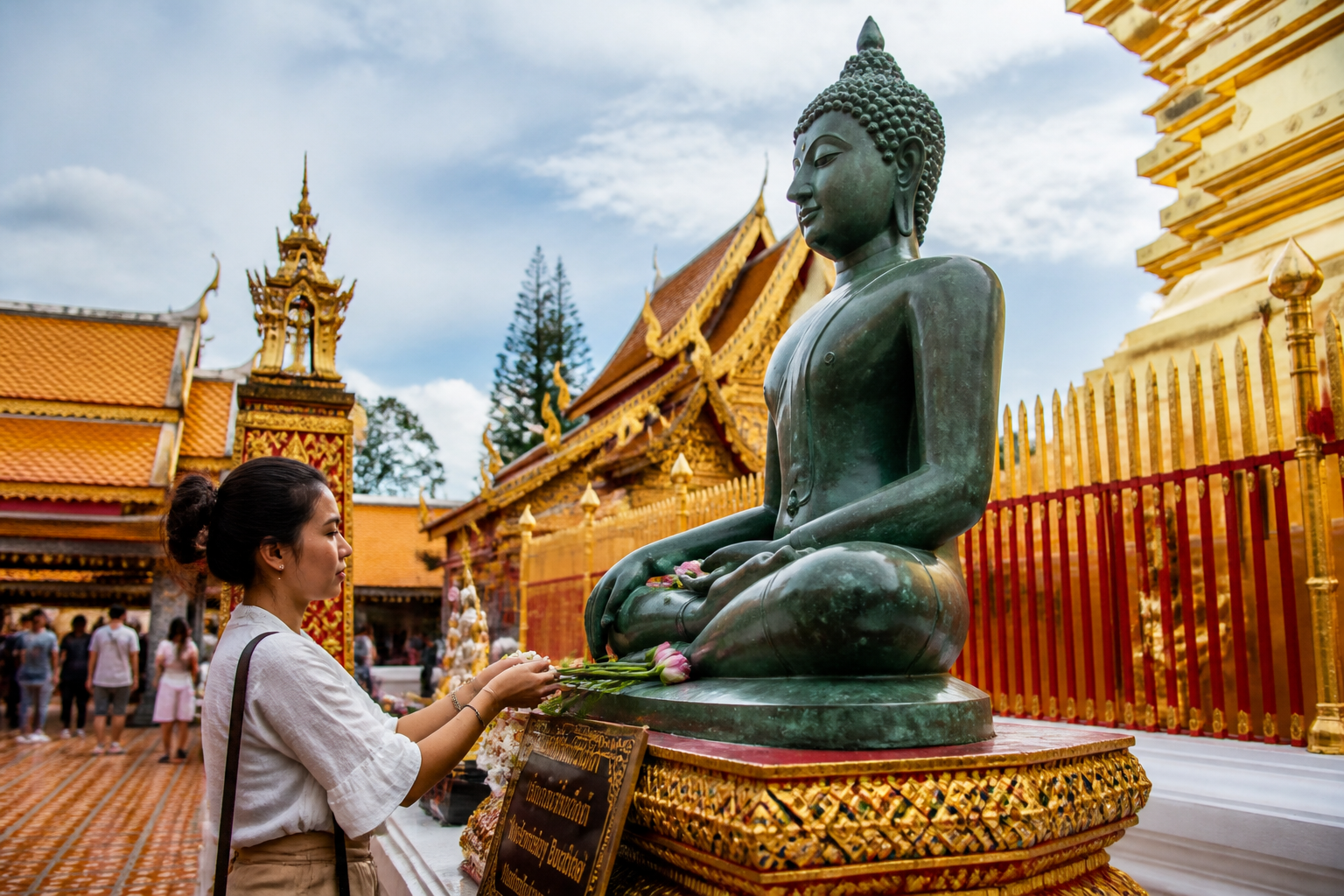
It is also a country with customs that may not be obvious to first-time visitors. A few small gestures—touching someone’s head, pointing your feet at a Buddha image, or stepping into a temple in beachwear—can come across as genuinely disrespectful.
I learned that the best way to enjoy Thailand is to stay curious, slow down a little, and watch what locals do around you.
## The Vibe & When to Go
Thailand feels lively without always feeling rushed. Bangkok is noisy, humid, and wonderfully chaotic, while Chiang Mai has a slower rhythm, with cafés, markets, temples, and mountain air. The islands bring a different mood altogether: lazy mornings, boat trips, and sunsets that somehow make everyone pause for a minute.
Thailand’s seasons vary by region:
– **November to February:** Generally the most comfortable period, with cooler, drier weather in much of the country.
– **March to May:** Very hot, especially in Bangkok and northern Thailand. Pack light clothes, sunscreen, and patience for walking at midday.
– **June to October:** Green, humid, and affected by monsoon showers. Rain often comes in heavy bursts rather than lasting all day, though ferry and beach plans can be disrupted.
– **Andaman coast:** Phuket, Krabi, and Koh Lanta usually have their best beach weather from roughly November to April.
– **Gulf coast:** Koh Samui, Koh Phangan, and Koh Tao follow a slightly different rainfall pattern, so check the forecast for the exact island.
Thailand is worth visiting in any season if you plan around the weather. During the rainy months, I actually enjoy the cooler afternoons and thinner crowds. Just leave room in your itinerary for a canceled boat trip.
## Must-See Spots: My Top Picks
### 1. Bangkok’s Old City Before the Heat
Start early at **Wat Pho**, where the reclining Buddha is impressive, but the temple’s quiet courtyards are what stayed with me. From there, walk toward **Wat Arun** or take a short river ferry across the Chao Phraya.
I prefer visiting the Grand Palace early in the morning, before the crowds and heat become tiring. Dress modestly—shoulders and knees covered—and carry a scarf or light shirt rather than relying on a rental wrap.
For a less polished but more local-feeling evening, wander through **Chinatown’s Yaowarat Road**. Go hungry, share small dishes, and look for stalls busy with Thai customers. A crowded plastic table often tells you more than a glossy restaurant sign.
### 2. Chiang Mai’s Temples and Quiet Lanes
Chiang Mai is a good place to slow down. **Wat Phra Singh** and **Wat Chedi Luang** are beautiful, but I also enjoy simply walking through the lanes around the Old City, especially early in the day when monks are heading out and cafés are opening.
Climb or drive up to **Wat Phra That Doi Suthep** for city views. If you go near sunset, expect crowds. A morning visit is cooler and usually more peaceful.
The **Sunday Walking Street Market** is great for snacks, handmade goods, and people-watching. Bring small bills and don’t assume every handmade item is a bargain—some prices are aimed at tourists.
### 3. Krabi’s Limestone Coast
The cliffs around **Railay** look almost unreal, but the beach can become busy by late morning. I like arriving on one of the first long-tail boats, swimming before the day-trippers arrive, and walking the short paths between Railay East, Railay West, and Phra Nang Beach.
For boat tours, ask exactly what is included: national park fees, lunch, snorkeling gear, and hotel transfers can all be charged separately. Private boats cost more but let you avoid spending the entire day following a packed tour group.
### 4. A Slower Island Stay
If you want nightlife, **Koh Phangan** and parts of Phuket will suit you. For a quieter few days, I’d look at **Koh Lanta**, quieter parts of **Koh Samui**, or smaller beaches away from the main resort areas.
One of my favorite island habits is to rent a bicycle where roads are flat and safe, then spend the day stopping at family-run cafés and small beaches. I avoid renting a scooter unless I am properly licensed and genuinely confident. Thailand’s roads are not the place to learn.
## Ten Things to Avoid in Thailand
These are not rules meant to make you nervous. They are simple ways to show respect and avoid common trouble.
### 1. Don’t Touch Anyone’s Head
In Thai culture, the head is considered the most spiritually significant part of the body. Avoid patting children’s heads, even affectionately, unless a parent clearly invites it.
A quick apology is appropriate if you make the mistake. Don’t turn it into a joke.
### 2. Don’t Point Your Feet at People or Buddha Images
Feet are considered the lowest and least clean part of the body. Don’t stretch your legs toward someone, point with your foot, or position your feet toward a Buddha image while sitting.
When sitting on the floor, tuck your feet behind you or to the side.
### 3. Don’t Enter Temples in Beachwear
A swimsuit, crop top, or very short shorts may be fine at the beach but not inside a temple. Cover your shoulders and knees, remove your shoes where required, and speak quietly.
Some temples provide cover-ups, but carrying a light shirt or sarong is easier.
### 4. Don’t Disrespect the Monarchy
Thailand’s royal family is treated with deep respect, and laws concerning defamation of the monarchy are strict. Avoid making jokes, damaging banknotes, or posting careless comments about the royal family.
If the national anthem plays in a public place, follow the people around you and stand respectfully.
### 5. Don’t Hand Things to Monks Casually
Women should avoid physical contact with monks and generally should not hand items directly to them. Place donations or offerings where the monk can collect them, or ask another person to pass them over.
Men should also avoid touching monks without a clear reason.
### 6. Don’t Bargain Aggressively Over Tiny Amounts
Bargaining is normal in some markets, but arguing for another 10 baht over a small purchase can leave a bad impression. Be friendly, know when to accept the price, and walk away politely if it is too high.
Prices in shopping malls and most restaurants are fixed.
### 7. Don’t Accept the First Taxi or Tuk-Tuk Offer Without Checking
Some drivers quote inflated prices, take passengers to commission-based shops, or claim a temple is closed when it is not. Use the meter in taxis where possible, or agree on a fare before getting in.
In Bangkok, **Grab** is useful for cars and motorbike taxis. **Bolt** can also be cheaper in some areas. For tuk-tuks, agree on the full price and destination before moving.
### 8. Don’t Ride a Scooter Without the Right License and Insurance
Thailand’s roads can be unpredictable, especially around islands and busy cities. An international driving permit may be required, and travel insurance may refuse a claim if you ride without the correct license.
A scratched knee can become an expensive problem very quickly. Use a songthaew, taxi, Grab, or hotel transfer instead if you are unsure.
### 9. Don’t Support Cruel Wildlife Attractions
Be cautious with places that offer tiger selfies, elephant bathing, performances, or direct animal contact. Some sanctuaries use kind language while still keeping animals in poor conditions.
Choose places that do not allow riding, forced bathing, breeding for entertainment, or handling. A genuine ethical center will usually explain its rescue and care work clearly.
### 10. Don’t Treat the Sea, Streets, or Drugs Casually
Do not swim beyond flags or ignore red warning signs, especially during rough weather. Strong currents are a real danger.
Drug laws are severe, and assumptions about cannabis rules can get travelers into trouble because regulations change. Buy only from legal, clearly regulated businesses if permitted, and never carry anything across borders.
Also, avoid drinking tap water unless your accommodation confirms it is filtered and safe. Bottled or filtered water is widely available.
## Practical Travel Advice
### Getting There and Visa Information
Bangkok is the main arrival point, with two international airports:
– **Suvarnabhumi Airport (BKK):** The larger airport, connected to the city by Airport Rail Link.
– **Don Mueang Airport (DMK):** Common for low-cost regional flights.
Thailand’s entry rules depend on your passport, nationality, trip length, and purpose. Many nationalities can enter visa-free for a limited stay, while others need an e-visa or visa in advance. Rules and permitted stay lengths change, so check the **official Thai embassy or immigration website** before booking.
Travelers should also check whether the **Thailand Digital Arrival Card (TDAC)** is required for their arrival date. Keep proof of onward travel, accommodation details, and enough funds available in case immigration asks.
For flights, compare Bangkok’s two airports carefully. A cheap ticket into Don Mueang may not be convenient if you later need to cross the city to catch a flight from Suvarnabhumi.
### Where to Stay
**Bangkok**
– **Riverside or Old Town:** Best for temples, historic sights, and a slower evening atmosphere.
– **Sukhumvit:** Convenient for restaurants, shopping, nightlife, and the BTS Skytrain.
– **Silom:** Good for business areas, food, and access to the MRT.
– **Chinatown:** Noisy and energetic, with excellent food right outside your door.
**Chiang Mai**
– **Old City:** Best for temples, markets, and walking.
– **Nimman:** More modern, with cafés, restaurants, and a younger feel.
– **Riverside:** Calmer and more relaxed, though usually a little farther from the main sights.
**The islands**
Choose the beach carefully rather than booking only by island name. A hotel near nightlife may be noisy, while a quiet beach can mean fewer shops, taxis, and restaurants.
### Getting Around
Bangkok’s **BTS Skytrain** and **MRT** are clean, fast, and usually much easier than sitting in traffic. Boats along the Chao Phraya River are useful for temple areas and make a pleasant change from road travel.
Elsewhere, you’ll find:
– Grab and Bolt for app-based rides
– Songthaews, which are shared pickup trucks
– Metered taxis in larger cities
– Long-tail boats for local water routes
– Domestic flights for long distances
– Trains for a slower, memorable journey between major destinations
Thailand is not always very walkable. Sidewalks can disappear, traffic may be heavy, and heat makes a short distance feel much longer. I usually plan one main walking area per morning and use a ride between neighborhoods.
## Real Costs and Local Tips
Thailand can fit many budgets, but Bangkok, Phuket, and popular islands are noticeably more expensive than smaller towns.
### Budget Travel
Around **700–1,200 baht per person per day**, excluding flights, if you stay in a hostel or simple guesthouse, eat local food, and use public transport.
A typical budget day might include:
– Hostel bed: 250–600 baht
– Local breakfast: 40–80 baht
– Street-food lunch: 50–100 baht
– Simple dinner: 80–180 baht
– Local transport: 50–200 baht
– One inexpensive attraction or drink
### Mid-Range Travel
Around **2,000–4,000 baht per person per day**, excluding flights, for a comfortable hotel, a mix of local and international meals, taxis, and a few paid activities.
Private island tours, diving, nightlife, and upscale beach hotels can push the daily cost much higher.
The currency is the **Thai baht (฿)**. Carry small notes for markets, street food, temple donations, and songthaews. Cards are common in hotels, shopping centers, and many restaurants, but small vendors may accept only cash.
Tipping is not compulsory, though it is appreciated. I usually round up a restaurant bill, leave 20–50 baht for good service, and tip guides or massage therapists more when they have done an excellent job. Check whether a service charge is already included.
### A Few Ways to Save Money and Avoid Trouble
– **Eat where locals eat:** Food courts, markets, and small neighborhood restaurants are usually cheaper than tourist streets.
– **Use the BTS, MRT, and river boats in Bangkok:** They often save both money and a lot of frustration.
– **Ask for the total price before a tour or taxi ride:** Confirm whether entrance fees, transfers, meals, and equipment are included.
– **Carry a reusable water bottle:** Many hotels, hostels, and cafés have filtered refill stations.
– **Avoid airport exchange counters for large amounts:** Withdraw from a reputable ATM or compare exchange rates in the city. Always check the ATM’s conversion option and choose to be charged in baht rather than your home currency.
– **Keep a photo of your passport:** Carry a copy for everyday use and keep the original secure unless required for a specific transaction.
– **Don’t rush a temple visit:** Early mornings are cooler, quieter, and often much more pleasant than arriving with a tour group at noon.
Thailand rewards travelers who pay attention. Smile, dress appropriately when visiting religious places, ask before taking photographs, and let local customs guide you when you are unsure. The country becomes much more enjoyable when you stop trying to control every moment and give yourself time to notice the small ones.
KEYWORDS: Thailand temple, Bangkok street food