
# Vietnam Is Having Its Moment: Street Food, Quiet Corners, and Practical Travel Tips
Vietnam has always had plenty to offer, but lately it feels like the rest of the world is catching up. More travelers are adding Hanoi, Da Nang, Hoi An, Phu Quoc, and the northern mountains to their plans—and after spending time there, I understand why.
Vietnam is easy to enjoy without spending a fortune. You can eat an excellent bowl of noodles for a few dollars, move between cities by overnight train, and go from busy café streets to rice fields or limestone mountains in a single day. The country can be noisy, chaotic, and wonderfully intense, but it also has a gentle side that shows up in early-morning markets, family-run guesthouses, and long conversations over strong Vietnamese coffee.
## The Vibe & When to Go
Vietnam feels energetic from the moment you arrive. Scooters stream through city streets, tiny plastic stools appear wherever food is being served, and cafés seem to occupy every spare corner. At the same time, there are plenty of peaceful places: misty mountain villages, riverside lanes, quiet beaches, and temples where the pace slows down.
The weather changes dramatically from north to south:
– **Northern Vietnam:** Hanoi and Ha Long Bay are cooler from November to March, while April to June brings warmer days and occasional rain. The mountains around Sapa can be chilly and misty in winter.
– **Central Vietnam:** Hoi An, Da Nang, and Hue are often sunny from February through August. Heavy rain and occasional storms are more common from September to January.
– **Southern Vietnam:** Ho Chi Minh City and the Mekong Delta are hot year-round. The dry season usually runs from December to April, with more frequent showers from May to November.
If you are choosing dates now, I would plan around the region you care about most rather than trying to find one perfect nationwide season. March to May is often a pleasant compromise for a multi-city trip, although central and southern Vietnam can feel very hot in the afternoons.
## Must-See Spots: My Favorite Stops
### 1. Hanoi’s Old Quarter and the quieter side streets
Hanoi is busy, but it rewards travelers who wake up early. Around Hoan Kiem Lake, you will see older residents exercising, dancing, or practicing tai chi before the traffic builds. The Old Quarter is lively and crowded, yet some of my favorite moments came from turning down a narrow side street and finding a tiny coffee shop above the buildings.
Try **egg coffee**, even if the idea sounds unusual. It is rich, sweet, and almost dessert-like. For breakfast, look for a small shop serving **pho bo** or **bun cha** rather than choosing a restaurant with a large photo menu.
A few practical tips:
– Walk around the Old Quarter early, before the streets become packed.
– Use a map pin when ordering a ride because addresses can be confusing.
– Crossing the road takes confidence. Walk slowly and steadily; scooters usually move around you.
### 2. Ninh Binh: limestone cliffs and river landscapes
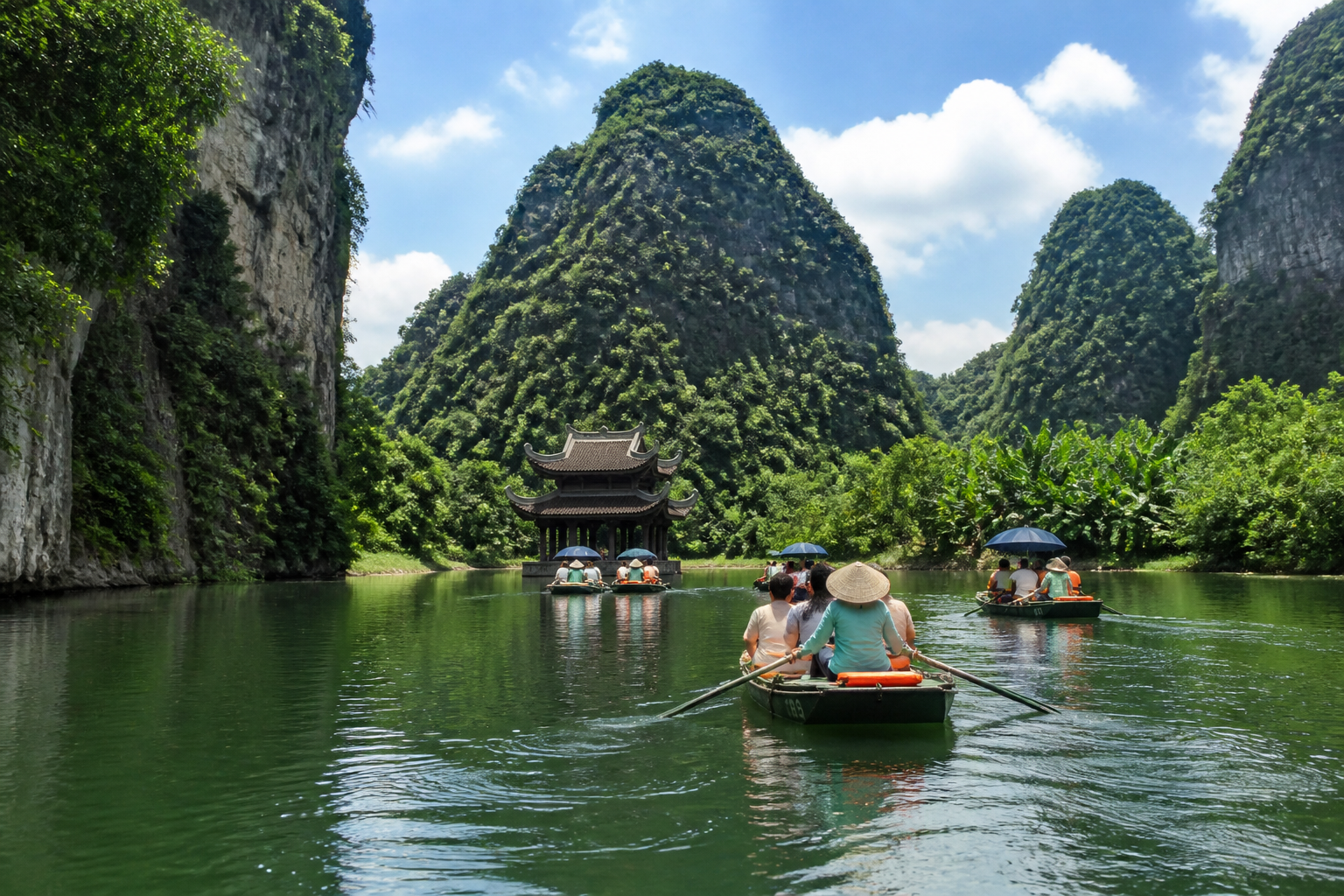
Ninh Binh is one of the easiest escapes from Hanoi, and I prefer it to rushing through a day trip. The boat rides around **Trang An** or **Tam Coc** pass between enormous limestone formations, caves, and green fields. The scenery is beautiful without requiring a difficult hike.
If you have time, stay one or two nights near Tam Coc. Rent a bicycle or scooter and visit **Bich Dong Pagoda** early in the morning, when the temple is quiet. The roads around the rice fields are much more enjoyable before tour buses arrive.
Trang An tends to feel more organized, while Tam Coc gives you easier access to cafés, guesthouses, and bike rentals. Both are good choices, but I would avoid trying to see every attraction in one rushed afternoon.
### 3. Hoi An after the tour groups leave
Hoi An’s lantern-lit old town can feel busy in the evening, but the town becomes much more pleasant once you wander a few streets away from the main riverside lanes. I loved cycling through the surrounding countryside, where narrow paths run between vegetable gardens and rice paddies.
The best time to explore the old town is early morning. Shopkeepers are opening their doors, delivery bicycles are passing through, and you can take photographs without standing shoulder to shoulder with other visitors.
Do not leave without trying:
– **Cao lau**, a local noodle dish with pork and herbs
– **White rose dumplings**
– Fresh banh mi from a small street vendor
– Vietnamese iced coffee with condensed milk
Hoi An is also famous for tailoring. If you want clothes made, bring a clear photo, ask about the fabric, and allow at least two fittings. Prices can be good, but quality varies. I would not order an entire wardrobe on the first afternoon.
### 4. Phong Nha or the Mekong Delta for a slower change of pace
For dramatic nature, **Phong Nha** is a fantastic choice. The area has enormous caves, jungle-covered hills, and a small-town atmosphere that feels much less polished than the major destinations. You do not need to book the most expensive expedition to enjoy it; Paradise Cave and the Phong Nha Cave boat trip are accessible options.
If you are traveling in the south, choose the **Mekong Delta** instead. I preferred staying overnight in Can Tho or a smaller riverside town rather than joining a hurried day tour from Ho Chi Minh City. Visit the floating market early, but keep expectations realistic: it is a working market, not a staged performance, and activity changes from day to day.
## Practical Travel Advice
### Getting There and Visa Requirements
Most international visitors enter through:
– **Hanoi:** Noi Bai International Airport
– **Ho Chi Minh City:** Tan Son Nhat International Airport
– **Da Nang:** useful for Hoi An, Hue, and central Vietnam
Vietnam offers electronic visas to citizens of many countries, generally allowing stays of up to 90 days with single or multiple entry options. Some nationalities also receive visa-free stays for shorter visits. Rules can change, so check the Vietnamese Immigration Department or your nearest Vietnamese embassy before booking non-refundable travel.
Make sure:
– Your passport has at least six months of validity.
– Your visa dates match your actual arrival and departure plans.
– Your entry airport or border crossing matches the information on your application.
– You save both a digital and printed copy of your approval document.
For flights, compare Hanoi and Ho Chi Minh City rather than assuming one will be cheaper. An open-jaw ticket—flying into Hanoi and home from Ho Chi Minh City—can save time and avoid backtracking.
### Where to Stay
Vietnam has accommodation for almost every budget. My neighborhood choices would be:
– **Hanoi:** The Old Quarter is best for first-time visitors and nightlife. Ba Dinh is quieter, greener, and more residential.
– **Ho Chi Minh City:** District 1 is convenient and lively. District 3 has good cafés and a more relaxed feel, while Thao Dien in District 2 suits longer stays and digital nomads.
– **Hoi An:** Stay near the old town for evening walks, or choose Cam Chau or Cam Thanh for more space and bicycle access.
– **Da Nang:** My Khe Beach is convenient for beach access and restaurants. The city center is better if you prefer local food and urban energy.
– **Ninh Binh:** Tam Coc is handy for restaurants and tours. Trang An is quieter and more rural.
– **Phong Nha:** The town is small, so staying near the main road makes booking transport and tours easier.
Guesthouses and small hotels are often excellent value. Read recent reviews about noise, hot water, and construction rather than relying only on the star rating.
### Getting Around
Vietnam is easier to navigate than it first appears.
– **In cities:** Grab is the most useful rideshare app for motorbike taxis and cars. Confirm the license plate before getting in.
– **On foot:** Hanoi’s Old Quarter, Hoi An, and central Da Nang are walkable, though traffic and uneven pavements can make walking slower than expected.
– **Between cities:** Trains are comfortable for scenic routes, especially Hanoi to Ninh Binh, Hue, Da Nang, and onward to Ho Chi Minh City. Overnight trains save on accommodation but are not always quiet.
– **Buses:** Sleeper buses are affordable and cover many routes. They can be cramped, and driving standards vary, so I usually pay more for a reputable operator.
– **Domestic flights:** Useful for long distances, particularly Hanoi to Ho Chi Minh City or Da Nang to either major city.
– **Scooters:** Great in smaller towns if you are an experienced rider. Check local licensing rules and insurance requirements first. I would not learn to ride for the first time in Hanoi or Ho Chi Minh City.
## Real Costs and Local Tips
Vietnam remains affordable, though prices rise in popular beach towns and during major holidays such as Tet.
### Typical daily budgets
**Budget traveler: approximately $25–45 per day**
– Hostel bed or simple guesthouse: $6–18
– Local meals: $1.50–4 each
– Coffee or fresh juice: $1–2
– Local transport: $2–8
– Occasional entrance fees or tours: $5–15
**Mid-range traveler: approximately $60–120 per day**
– Comfortable hotel: $30–75
– Restaurant meals and cafés: $15–30
– Grab rides and occasional private transfers: $5–20
– Day tour or attraction fees: $10–35
The currency is the **Vietnamese dong (VND)**. Prices can look confusing because of the large numbers, so double-check whether something costs 50,000 or 500,000 dong before paying. Cards are accepted at many hotels and modern restaurants, but cash is still essential for markets, street food, small cafés, and rural areas.
Tipping is not compulsory. You can round up a taxi fare, leave a small amount for excellent service, or tip a guide around 50,000–100,000 dong depending on the tour. Staff should not expect a large American-style percentage.
### A few money-saving habits that helped me
– **Eat where locals eat.** A crowded plastic-stool restaurant is often cheaper and tastier than a quiet place aimed at tourists.
– **Use Grab instead of negotiating every ride.** It gives you a price in advance and avoids many awkward fare discussions.
– **Carry smaller notes.** Vendors may not have change for 500,000 dong, especially early in the morning.
– **Book popular trains and hotels ahead during Tet and public holidays.** Prices rise quickly, and transport can sell out.
– **Ask whether a menu price includes service or tax.** This is especially useful at upscale restaurants and hotel cafés.
– **Buy bottled water from supermarkets or convenience stores.** It is usually cheaper than buying it from hotel minibars or tourist attractions.
– **Take a photo of your hotel address in Vietnamese.** Showing it to a driver is often easier than trying to pronounce it.
Vietnam’s growing popularity has brought more flights, better accommodation, and a wider range of tours, but the country still feels most rewarding when you leave room for ordinary moments. Sit down for a bowl of noodles, follow the smell of grilled pork, take the slower train, and allow yourself an unplanned afternoon. Those are often the memories that stay with you longest.
KEYWORDS: Vietnam travel, Vietnamese landscape