
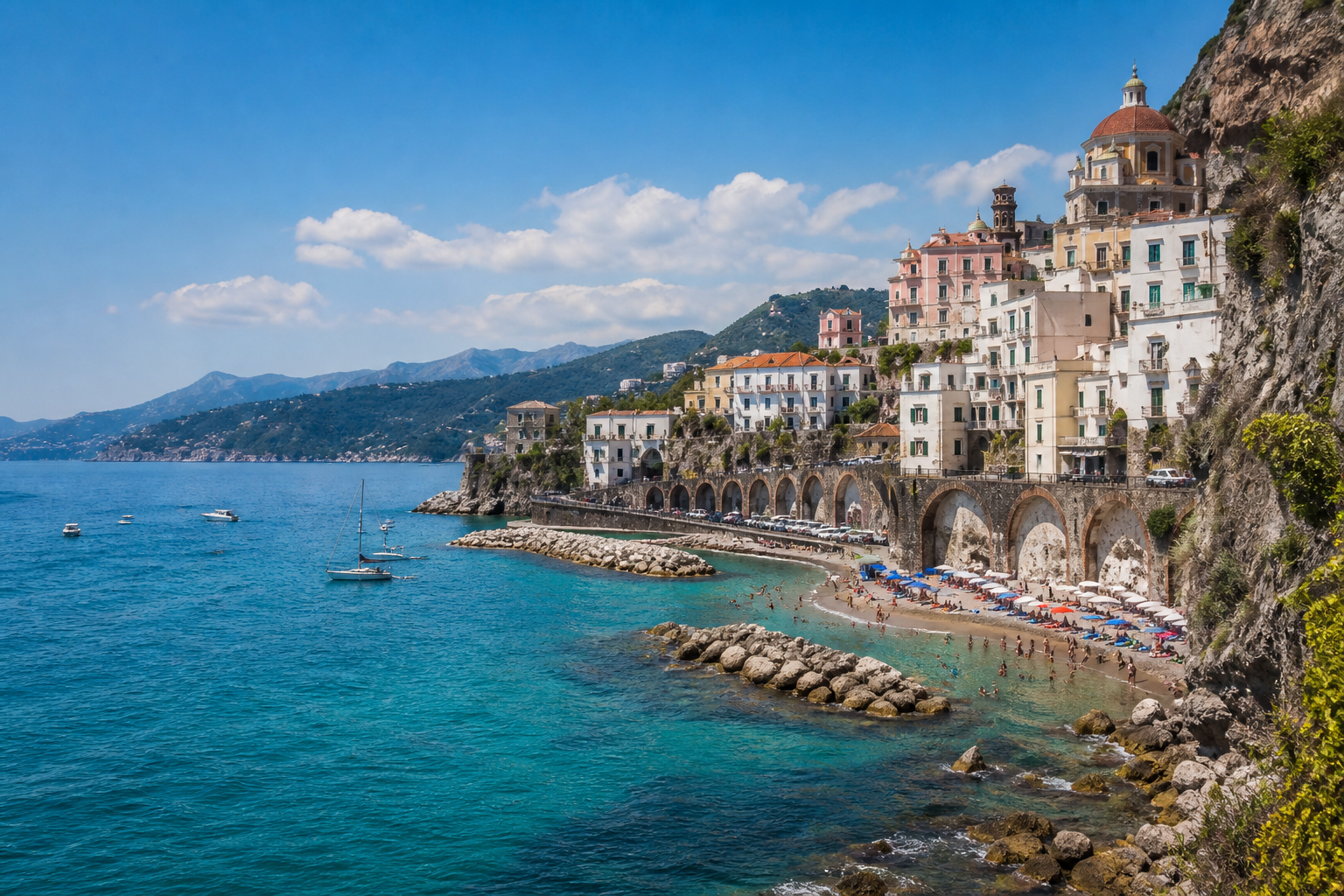
# Southern Europe in Summer: My Favorite Stops, Sea Breezes, and Honest Travel Costs
Europe now takes about one-third of global leisure travel spending, according to the World Travel & Tourism Council, and Southern Europe is where much of the summer energy gathers. After spending time moving between Portugal, Spain, Italy, and Greece, I understand why. The days are long, the food is meant to be shared, and even a quick walk to dinner can turn into an evening of music, conversation, and people-watching.
The region is busy in summer, sometimes almost too busy, but it still has plenty of quiet corners if you plan around the crowds.
## The Vibe & When to Go
Southern Europe in July and August feels bright, social, and a little unruly in the best way. Cafés stay full late into the night, beaches fill early, and locals often disappear for a long lunch before reappearing after sunset.
Expect hot weather:
– **Portugal and coastal Spain:** usually warm to very hot, with cooler evenings near the Atlantic
– **Italy and Greece:** hot, dry, and sunny, especially in July and August
– **Southern inland cities:** often uncomfortably hot in the afternoon, with temperatures reaching the mid-30s Celsius
I prefer **May, June, September, or early October**. You still get swimming weather in many coastal areas, but hotel prices are kinder and famous sights are easier to enjoy. If summer is your only option, plan sightseeing before 10 a.m. or after 5 p.m. and leave the middle of the day for lunch, shade, or the sea.
## Must-See Spots: My Top Picks
### 1. Lisbon, Portugal: tiled streets and excellent little meals
Lisbon is a gentle place to begin. I love wandering through Alfama early in the morning, before the steep lanes fill with tour groups. The city is scruffy in places, colorful in others, and full of tiny bakeries where a warm pastel de nata costs very little.
Take tram 28 if you really want the experience, but walk whenever you can. The tram gets packed, and pickpockets know exactly where tourists stand. For a quieter view, head to **Miradouro da Senhora do Monte** or **Miradouro de Santa Catarina** near sunset.
My favorite Lisbon habit is simple: order petiscos, Portugal’s answer to small plates, and let dinner stretch out. For a day near the water, take the train from Cais do Sodré to Cascais rather than paying for an expensive private tour.
### 2. Seville, Spain: orange trees, late dinners, and shade
Seville has a different rhythm. It is lively, proud, and very hot in summer. The best way to enjoy it is to accept the local schedule: explore in the morning, rest during the hottest hours, and go out again when the streets cool down.
The **Real Alcázar** is the headline attraction, but I enjoyed getting lost around the nearby Santa Cruz lanes even more. Book the Alcázar online and choose an early entry time. The **Plaza de España** is beautiful at sunrise, when the tiled alcoves are empty and the stone is still cool.
For food, look beyond restaurants with picture menus. Try salmorejo, grilled prawns, fried fish, and a few small tapas at a busy neighborhood bar. Dinner may not begin until 9 p.m., so have a snack earlier if you are used to eating at six.
### 3. Puglia, Italy: white towns and slow coastal days
Puglia rewards travelers who are willing to move a little more slowly. **Ostuni**, **Polignano a Mare**, and **Monopoli** are easy to combine, though each becomes crowded in the afternoon.
I liked staying in Monopoli and taking short train trips rather than changing hotels every night. The old harbor is especially pleasant at dusk, when fishermen bring in their boats and the stone walls turn honey-colored.
For a quieter beach day, ask locally about smaller coves outside the most famous towns. Renting a car helps if you want to explore inland villages, olive groves, and farm stays, but parking in historic centers can be a headache. Leave the car outside the old town and walk in.
Do not rush meals here. Orecchiette pasta, burrata, grilled vegetables, and a simple seafood lunch can easily become the best part of the day.
### 4. Athens and the nearby islands, Greece: ancient stone and late-night energy
Athens can feel intense at first—traffic, heat, scooters, and hills—but it becomes much more welcoming once you slow down. Visit the Acropolis as early as possible, then spend the afternoon in the Acropolis Museum or under the shade of Plaka’s quieter lanes.
I prefer staying around **Koukaki**, where you can walk to major sights and still find ordinary cafés and bakeries. **Psyrri** is better for nightlife, while **Kolonaki** feels polished and generally costs more.
If you have four or five extra days, take a ferry to **Aegina** or **Agistri** instead of immediately choosing the most famous islands. They are easier to reach from Athens and can feel less exhausting than a long ferry journey followed by another crowded destination.
## Practical Travel Advice
### Getting There and Visa
For a multi-country trip, look for an open-jaw flight: fly into Lisbon, Barcelona, Rome, or Athens and return from another city. This saves backtracking and can be cheaper than buying separate trains or flights later.
Most of these countries are part of the **Schengen Area**. Travelers from countries such as the United States, Canada, Australia, and the United Kingdom can generally visit visa-free for up to **90 days within a 180-day period**, but passport rules vary. Check the official immigration website for your nationality before booking. Your passport should usually be valid for at least three months after your planned departure and issued within the last ten years.
If you are visiting several Schengen countries, you normally apply through the country where you will spend the most time. Carry proof of accommodation, onward travel, and travel insurance in case border officials ask.
### Where to Stay
– **Lisbon:** Baixa or Chiado for convenience; Alfama for atmosphere; Estrela for a calmer, more local feel
– **Seville:** Santa Cruz for charm, Alameda for restaurants and nightlife, Triana for a neighborhood atmosphere
– **Puglia:** Monopoli for train access and coastal evenings; Ostuni for postcard scenery; a countryside masseria for peace and space
– **Athens:** Koukaki for walkability, Psyrri for nightlife, Pangrati for cafés and a more residential feel
In July and August, air-conditioning matters more than a beautiful lobby. I also check recent reviews for noise, elevator problems, and the distance from the nearest transport stop.
### Getting Around
Southern European city centers are often best explored on foot, though comfortable shoes are essential. Lisbon and Athens have steep sections, and old-town paving can be uneven.
For longer distances:
– Use high-speed trains between major Italian and Spanish cities.
– Portugal’s trains are useful for Lisbon, Porto, and coastal day trips.
– Ferries connect Greek islands, but schedules can change with wind.
– In Puglia and rural Greece, a rental car gives you much more freedom.
– Uber, Bolt, and Free Now operate in many cities, though availability varies.
– Spain also has Cabify in several cities, while Italy has local taxi apps such as itTaxi.
Book trains and popular ferries ahead during summer, especially for Friday and Sunday travel.
## Real Costs and Local Tips
Prices vary sharply by city and season, but these are reasonable summer estimates per person:
### Budget travel: €55–€90 per day
– Hostel bed or basic room: €25–€50
– Bakery breakfast or coffee: €4–€8
– Casual lunch: €8–€15
– Simple dinner: €12–€25
– Public transport and small sights: €5–€15
### Mid-range travel: €130–€220 per day
– Private room or comfortable hotel: €80–€150
– Breakfast and two relaxed meals: €35–€60
– Attractions, local transport, and occasional taxis: €20–€45
The euro is used in Portugal, Spain, Italy, and Greece. Tipping is not handled exactly like it is in the United States. Check the bill first; a service charge may already be included. If not, rounding up or leaving **5–10%** for genuinely good service is usually appreciated, but it is not mandatory.
A few things that saved me money:
– **Eat lunch at local cafés.** Set menus are often far cheaper than dinner, especially in Spain and Italy.
– **Avoid restaurants directly beside major monuments.** Walk two or three streets away and look for a menu without photos or aggressive staff outside.
– **Book major attractions early.** This prevents both sold-out tickets and expensive last-minute tour purchases.
– **Carry a water bottle.** Many cities have public fountains, and buying small bottles all day quietly eats into your budget.
– **Travel between cities early or late.** Midday trains and ferries are often the most expensive and crowded.
– **Ask for the house wine or local beer.** It is usually better value than imported brands, and often more connected to the place you are visiting.
Southern Europe is not a single kind of trip. You can spend a week swimming, eating, and barely checking the time, or build an ambitious route through four countries. I prefer leaving space between the big sights. Some of my best memories came from an unplanned bakery stop, a late train conversation, or a beach that was not listed in any guidebook.
KEYWORDS: Southern Europe, Mediterranean coast