
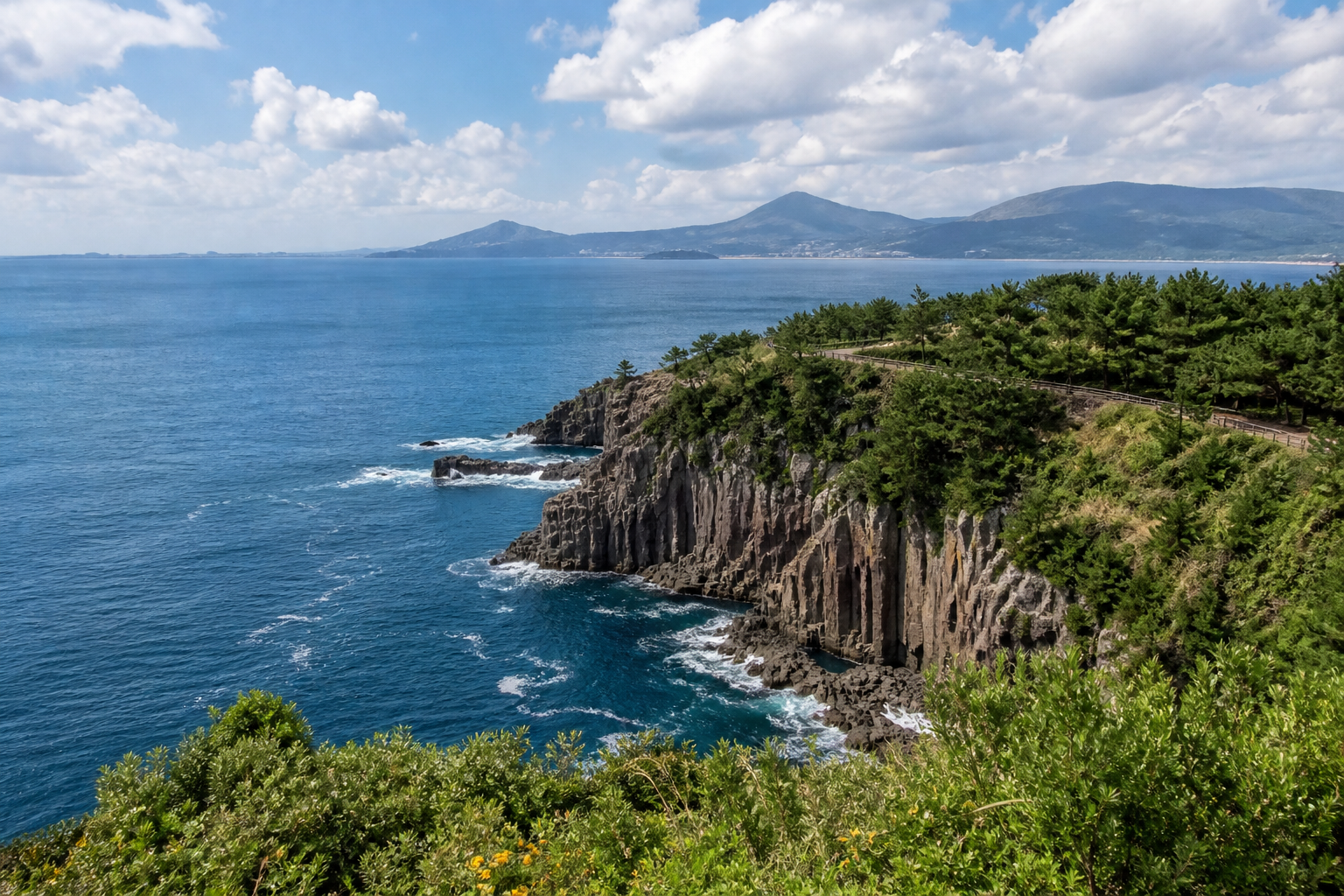
# Korea’s Big Three Views: Mountains, Sea Cliffs, and Sunrise Islands
South Korea surprised me with how quickly the scenery changes. One day I was looking across jagged mountain ridges, the next I was eating grilled shellfish beside the sea, and a few days later I was watching the sun rise from a volcanic crater.
For a trip built around unforgettable views, I’d choose **Seoraksan National Park, Busan, and Jeju Island**. They each show a different side of Korea: quiet mountain trails, lively coastal neighborhoods, and wide-open island landscapes.
## The Vibe & When to Go
**Spring and autumn are the easiest seasons for this itinerary.** In spring, the air is usually mild, flowers appear along walking paths, and the mountains are beginning to turn green. Autumn brings crisp skies and brilliant color, especially in Seoraksan. Summer is humid and rainy at times, but it’s good for beaches. Winter can be beautiful, though mountain trails may be icy.
The best part of traveling now is that each destination gives you a different kind of view without requiring extreme hiking. You can ride a cable car, walk a coastal path, or reach a lookout by city bus.
—
# 1. Seoraksan National Park: Korea’s Most Dramatic Mountain Scenery
Seoraksan was the place that made me stop checking my phone. Gray granite peaks rise sharply above forests, streams, and small temples, and the scenery changes every few minutes along the trails.
### What I loved most
**Ulsanbawi Rock**
This is the famous rocky ridge, and the climb is a serious workout rather than a casual stroll. The stairs seem to keep going, but the view from the top makes the tired legs worthwhile. Go early if you can. By late morning, the trail becomes much busier.
Wear proper shoes and bring water. The final section is exposed, so wind can make the top feel much colder than the entrance.
**Gwongeumseong Fortress by cable car**
If you want mountain views without a long hike, take the cable car from Seoraksan entrance. It brings you close to a rocky viewpoint with sweeping views over the valley and peaks.
The cable car can have a queue, particularly on weekends and during autumn foliage. I’d arrive before 9 a.m. rather than hoping to walk straight onto it.
**Biryong Falls**
This is a gentler choice, with a pleasant forest path and a waterfall at the end. The sound of running water makes the walk feel wonderfully removed from the outside world. After heavy rain, the falls are especially impressive, although some paths may close for safety.
**Sinheungsa Temple**
Near the park entrance, Sinheungsa is easy to visit even if you are not planning a long hike. The enormous bronze Buddha and the surrounding mountain walls create one of those scenes that feels much larger in person than in photos.
### Where to stay near Seoraksan
Stay in **Sokcho** if you want better restaurants, cafés, and transport. The area around Sokcho Beach is convenient and pleasant in the evening. For an early start, choose a guesthouse or hotel closer to the national park entrance.
### Getting there
From Seoul, buses to Sokcho usually take around two and a half to three hours, depending on traffic. From Sokcho, local buses or taxis take you to the park entrance. Kakao T is useful for booking taxis, although a regular taxi from the street is also fine.
—
# 2. Busan: Ocean Views with a Real City Around Them
Busan feels relaxed compared with Seoul, but it still has plenty happening. Its best views are not all in one place: beaches, cliffs, hillside streets, bridges, and seafood markets are spread across the city.
### My favorite Busan views
**Haeundae and the coastal Blue Line Park**
Haeundae is the classic Busan beach, but I enjoyed the coast even more from the Blue Line Park route toward Cheongsapo. You can take the colorful Sky Capsule or walk sections of the old railway line beside the water.
The Sky Capsule is charming but popular, so reserve ahead if you have your heart set on it. Walking is cheaper and gives you more freedom to stop for photographs.
**Gamcheon Culture Village**
The painted hillside houses are Busan’s most recognizable sight. The main lanes can feel crowded, but if you move away from the postcard viewpoints, you’ll find quieter stairways, tiny galleries, and cafés overlooking the rooftops.
Wear shoes with good grip. The streets are steep, and some alleys are residential, so keep voices low and avoid photographing people’s homes too closely.
**Taejongdae Resort Park**
Taejongdae has rugged cliffs, pine trees, and wide views of the Korea Strait. The park train is useful if you don’t want to walk the full route, but I liked getting off and exploring the quieter paths on foot.
The lighthouse area is usually the highlight. On clear days, the horizon seems to stretch forever.
**Hwangnyeongsan Mountain**
For a city panorama, head to Hwangnyeongsan around sunset. You can see Busan’s bridges, towers, and dense neighborhoods spreading toward the sea. A taxi is the simplest way up, especially at night. Bring a light jacket, even in warmer months.
### Where to stay in Busan
– **Haeundae:** Best for beaches, modern hotels, and easy evening walks
– **Seomyeon:** Best for food, nightlife, and central subway connections
– **Nampo-dong:** Good for markets, harbor views, Jagalchi Fish Market, and older Busan
– **Gwangalli:** My favorite for cafés and nighttime views of Gwangan Bridge
### Getting around Busan
The subway covers most major areas and is inexpensive. Use a rechargeable **T-money card** for trains and buses. For places such as Taejongdae or Hwangnyeongsan, a taxi can save a lot of time and is usually reasonable when shared.
—
# 3. Jeju Island: Volcanic Landscapes and Wide Open Horizons
Jeju has a slower rhythm. Even when the main sights are busy, you can usually find a quieter road, a black-rock beach, or a small café with a view.
The island is large enough that trying to see everything in two days becomes tiring. I prefer choosing one side of the island and leaving room for weather changes.
### Places I’d make time for
**Seongsan Ilchulbong**
This volcanic crater rising from the coast is one of Jeju’s essential sights. The climb is short but steep, and reaching the top early in the morning gives you the best chance of avoiding crowds and strong heat.
Despite its name, you don’t have to visit at sunrise. The view is still beautiful later in the day, especially when the sea is bright and clear.
**Seopjikoji**
A short drive from Seongsan, Seopjikoji has open coastal paths, dark volcanic rock, and dramatic sea views. The wind can be surprisingly strong, so hold onto hats and loose scarves.
I enjoyed this area more when I slowed down and followed the shoreline instead of rushing toward the main photo spots.
**Hallasan National Park**
You don’t need to climb to the summit to experience Hallasan. Several shorter trails lead into the forest and give you a taste of the island’s volcanic interior. If you plan a summit hike, check permits, weather, trail conditions, and starting times well in advance.
Clouds can appear quickly on the mountain, even when the coast is sunny.
**Jusangjeolli Cliff**
These tall, hexagonal volcanic columns along the southern coast look almost hand-carved. The viewing platforms are easy to reach, making this a good stop for a day that includes other sights around Seogwipo.
### Where to stay on Jeju
– **Jeju City:** Convenient for the airport, buses, and a first or final night
– **Seogwipo:** Better for waterfalls, southern coast scenery, and a quieter evening atmosphere
– **Seongsan:** Ideal for an early visit to Seongsan Ilchulbong
– **Aewol:** Good for coastal cafés and sunset drives
### Getting around Jeju
A rental car is the most practical option if you want to visit several scenic areas. Roads are generally easy to follow, but allow extra time for traffic and parking.
Without a car, stay in one area and use buses, taxis, or organized day tours. Kakao T works well for taxis. Google Maps is not always reliable for walking and driving directions in Korea, so use **Naver Map** or **KakaoMap** instead.
—
## Getting There & Visa Information
Most international visitors fly into **Incheon International Airport near Seoul**. From there, you can take a domestic flight to Jeju or travel by express bus or train toward Busan and Sokcho.
For Busan, flying directly into **Gimhae International Airport** can save time if your route allows it. Jeju has its own international airport, though many overseas travelers connect through Seoul or Busan.
Visa rules depend on your passport. Some nationalities can enter Korea visa-free for short stays, while others need to apply for a visa before departure. Some visa-exempt travelers may also need a **K-ETA**, although requirements and temporary exemptions can change. Check the official Korean immigration or embassy website shortly before booking.
Your passport should be valid for the period required by Korean authorities, and you may be asked for an onward or return ticket.
—
## Realistic Costs
South Korea can be comfortable on a modest budget, especially if you eat at local restaurants and use public transport.
### Budget traveler: around **₩70,000–₩110,000 per day**
– Guesthouse or simple hostel: ₩25,000–₩50,000
– Local meals: ₩8,000–₩15,000 each
– Public transport: ₩5,000–₩10,000
– Coffee, snacks, and small entrance fees: ₩10,000–₩20,000
### Mid-range traveler: around **₩150,000–₩250,000 per day**
– Comfortable hotel: ₩90,000–₩170,000
– Restaurants and cafés: ₩35,000–₩60,000
– Taxis, activities, and admissions: ₩20,000–₩50,000
Prices rise during Korean holidays, autumn foliage season, and summer weekends, particularly in Jeju and coastal Busan.
The currency is the **South Korean won (KRW)**. Cards are accepted almost everywhere, but keep some cash for market stalls, small eateries, buses, and rural areas. Tipping is not expected in ordinary restaurants or taxis. A warm thank-you is enough.
## A Few Tips That Saved Me Money and Stress
– Buy a **T-money card** at a convenience store or subway station. It works on buses and subways in many cities.
– Use **Naver Map or KakaoMap** rather than relying entirely on Google Maps.
– For popular attractions, go early. This matters most at Seongsan Ilchulbong, the Blue Line Park, and Seoraksan cable car.
– Convenience stores are genuinely useful for affordable breakfasts, picnic lunches, bottled water, and late-night snacks.
– On Jeju, don’t book a car for the entire trip unless you need one. Public transport and taxis can cover a city-based stay, while a one-day rental may be enough for remote coastlines.
– In Busan, compare the subway route with a taxi before assuming a taxi will be expensive. Two or three people sharing the fare can make it surprisingly reasonable.
– Check mountain and ferry conditions on the day of travel. Weather changes quickly, especially around Seoraksan and Hallasan.
If I had to choose only one destination, I’d pick **Jeju for the greatest variety of landscapes**. For the easiest city break, Busan is hard to beat. And for that feeling of standing in front of something much older and bigger than yourself, Seoraksan stays with me the longest.
KEYWORDS: South Korea mountains, Jeju coastline