
# Chenab Rail Bridge: A Quiet New Chapter for Travel in Jammu and Kashmir
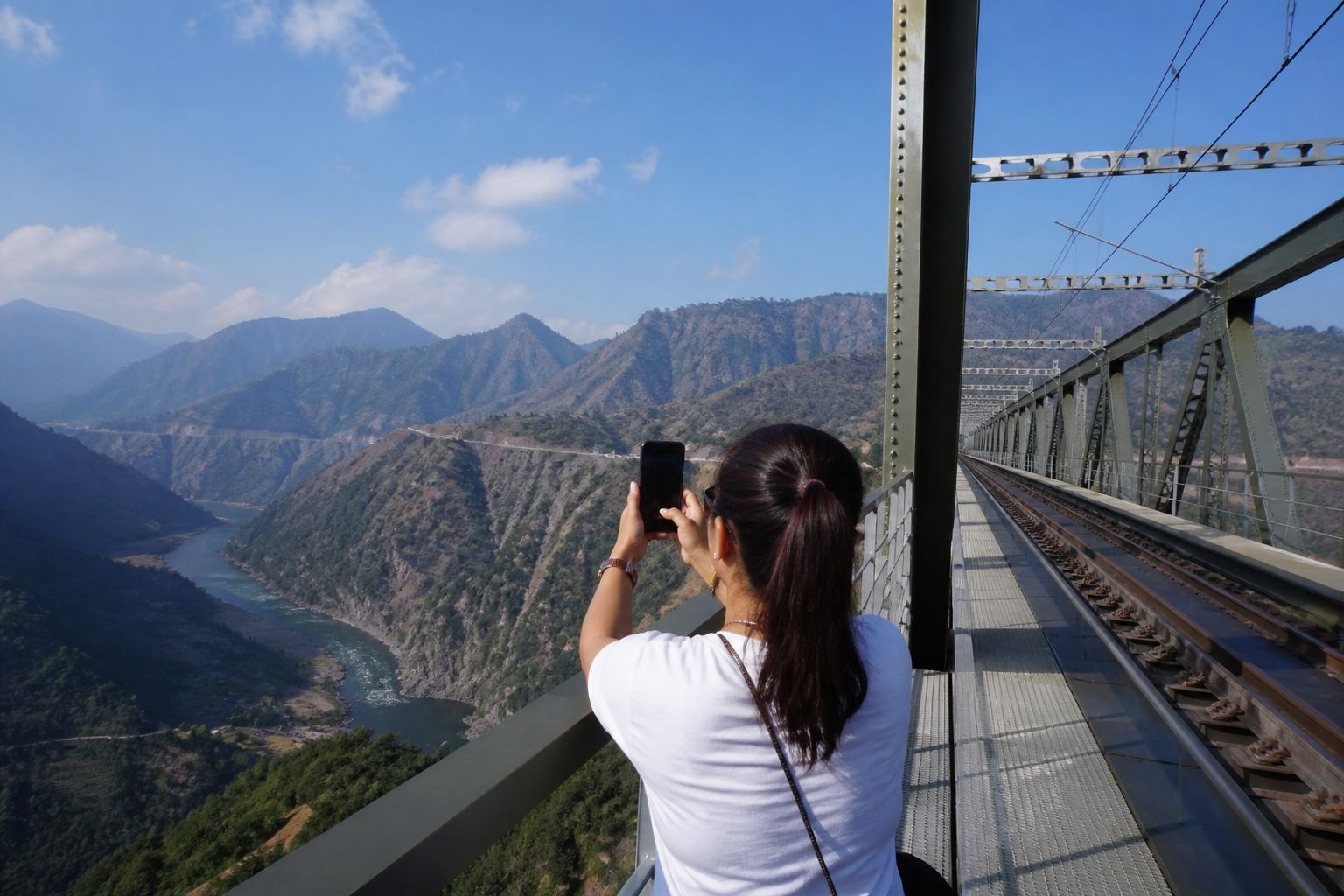
There is something wonderfully dramatic about seeing a train cross a bridge suspended high above a mountain river. The Chenab Rail Bridge, near Reasi in Jammu and Kashmir, has that rare kind of scale that makes you go quiet for a moment. The steel arches stretch across the Chenab River, with steep green-and-brown mountains rising on either side.
The bridge is now being presented as a new tourist attraction, but this is still an emerging destination rather than a fully polished sightseeing circuit. That is part of its charm. You will find fewer crowds, small roadside tea stalls, local taxis, and viewpoints that feel more like discoveries than official attractions.
## The Vibe & When to Go
The Reasi area feels much quieter than Srinagar or central Jammu. Roads wind through dry hills, villages appear around bends, and the landscape changes quickly from dusty summer slopes to vivid green after the rains.
The bridge itself is an astonishing sight: about **1,315 metres long** and roughly **359 metres above the Chenab River**. From a distance, it looks almost too large for the valley around it.
**Spring and autumn are the most comfortable times to visit**, especially from March to May and September to November. Days are generally pleasant for driving and sightseeing, while the skies are often clearer for photographs. Summer can be hot in the lower Jammu region, and monsoon showers may bring greenery but also slippery roads and occasional travel delays.
Winter has its own appeal, with crisp air and snow on higher slopes, though mornings can be cold and some roads may become difficult. Before travelling, check the local weather and road situation—mountain conditions can change quickly.
Because this is a newly promoted tourist destination, access rules and viewing areas may change. The railway bridge is an active railway structure, so visitors should never walk on the tracks or approach restricted areas. Use only officially approved viewpoints or tourism facilities.
## Must-See Spots: My Top Picks
### 1. The Chenab Rail Bridge Viewpoints
The main reason to come is, naturally, the bridge. But seeing it from the right angle matters. A roadside glimpse is impressive, while a proper viewpoint lets you appreciate the full arch, the river far below, and the tiny-looking roads cut into the hillsides.
Take your time with photographs rather than rushing through a quick stop. Early morning often gives softer light and fewer people. Late afternoon can bring warmer colours to the steel structure, though mountain shadows arrive quickly.
Since public viewing arrangements are still developing, ask your hotel or local taxi driver which viewpoints are currently open. Do not rely on old social media posts—some locations may be on private land or temporarily closed.
### 2. Reasi Town and the Old Fort
Reasi is a useful base for exploring the bridge and has a more everyday feel than the pilgrimage centre of Katra. The old fort area offers a glimpse into the region’s history and a chance to slow down after the long drive.
I enjoy places like this because they are not just photo stops. You may see local families out in the evening, shopkeepers closing up for the day, and children playing in the lanes. Wear comfortable shoes, and keep your expectations realistic: this is a historic local site, not a heavily restored palace complex.
### 3. Salal Dam and the Chenab Valley
The drive through the Chenab Valley is almost as memorable as the bridge itself. Depending on current access and road conditions, the Salal Dam area and nearby river viewpoints can add another half-day to your trip.
The scenery becomes especially attractive after the rains, when the slopes look greener and the river has more energy. Pack water and snacks because facilities become sparse outside the main towns. Always check whether a dam or security-sensitive area allows photography before taking out your camera.
### 4. Katra and the Vaishno Devi Route
Most visitors will combine the Chenab Bridge with a stay in Katra, the main starting point for the Vaishno Devi pilgrimage. Even if you are not making the full pilgrimage, Katra is convenient, busy, and has the widest choice of hotels and restaurants in the area.
The town is more crowded and commercial than Reasi, but it makes a practical base. You can spend one day around Katra and another on a pre-arranged bridge and Reasi excursion. Start early, especially during pilgrimage seasons and public holidays, when roads and hotels fill quickly.
## Practical Travel Advice
### Getting There and Visa
The closest useful airports are:
– **Jammu Airport:** the most practical airport for Reasi, Katra, and the bridge area
– **Srinagar Airport:** possible if you are already touring Kashmir, but the journey to Reasi is much longer
– **Jammu railway station:** useful for travellers arriving by train from Delhi and northern India
– **Katra railway station:** convenient for Vaishno Devi and onward road travel, when your train schedule allows
From Jammu, Katra, or Reasi, you will generally need a local taxi for the bridge area. Public transport exists between towns, but it is not the easiest choice if you want to stop at viewpoints.
Foreign visitors need a valid passport and an Indian visa, or an eligible Indian e-Visa arranged before travel. Jammu and Kashmir can have changing security and access guidelines, so check the latest information from the Indian visa website, your airline, and official Jammu and Kashmir tourism sources. Indian citizens do not need a visa, but photo identification is sensible for transport and hotel check-ins.
### Where to Stay
**Katra:** Best for first-time visitors, pilgrims, families, and travellers who want plenty of hotels and restaurants. Choose a hotel near the main market or railway station for convenience.
**Reasi:** Better for a quieter stay and earlier access to the bridge and surrounding valley. Accommodation is more limited, so book ahead if you want a specific hotel.
**Jammu:** A good choice if you are only making a day trip or prefer city comforts, shopping, and a wider range of restaurants. The drive to the bridge will be longer.
There are limited options close to the bridge itself. I would not plan on finding a charming mountain resort right beside the attraction; stay in Katra or Reasi and arrange transport locally.
### Getting Around
A private taxi is the simplest option. Ask for a full-day rate rather than negotiating separately for every short stop. Confirm whether fuel, waiting time, parking, and the driver’s return journey are included.
Shared jeeps and local buses can reduce costs between Jammu, Katra, and Reasi, but they may not stop near the best viewpoints. App-based services such as Uber and Ola should not be treated as dependable once you leave the main cities. Local taxi stands are more useful in this part of Jammu.
Carry some cash, download offline maps, and keep your phone charged. Mobile coverage can become patchy in the hills.
## Real Costs and Local Tips
Prices change during pilgrimage periods and holidays, but these are sensible planning figures per person.
### Budget travel
– Shared transport and local buses: **₹500–₹1,200 per day**
– Simple guesthouse or budget hotel: **₹800–₹1,800**
– Local meals, tea, and snacks: **₹400–₹700**
– Shared taxi or group excursion: **₹800–₹1,500**, depending on distance and group size
A realistic budget is around **₹1,800–₹3,500 per person per day**, excluding long-distance travel.
### Mid-range travel
– Comfortable hotel room: **₹3,000–₹6,500**
– Private taxi for sightseeing: **₹2,500–₹5,500 per vehicle**
– Meals at decent restaurants: **₹800–₹1,500**
– Miscellaneous costs and entry fees: **₹300–₹800**
For two people sharing a room and taxi, expect roughly **₹4,500–₹8,000 per person per day**.
The local currency is the **Indian rupee (INR)**. Tipping is not compulsory, but rounding up a restaurant bill or giving a small amount to a helpful driver is appreciated. For a full-day taxi, a tip of **₹200–₹500** is reasonable if the service was good.
### A few things that make the trip easier
– **Book your stay before arriving**, especially during Navratri, weekends, and Vaishno Devi pilgrimage seasons.
– **Carry cash in smaller notes.** Cards and digital payments work in many places, but not everywhere in the hills.
– **Ask about the total taxi price before leaving.** Confirm whether tolls, parking, waiting, and return travel are included.
– **Avoid unofficial “secret viewpoints.”** Some may involve private land, unsafe edges, or restricted railway areas. A local driver or tourism office can point you toward legitimate viewing spots.
– **Bring water, a hat, and a light jacket.** The sun can feel strong, while the air changes quickly once you are above the river valley.
– **Do not expect the bridge to function like a normal monument.** Railway operations and safety rules come first, and access may be limited to designated areas.
The Chenab Rail Bridge is still finding its place on the travel map. That means the visit may require a little patience and planning, but it also gives you the feeling of arriving before the crowds and souvenir stalls take over. Come for the engineering, stay for the mountain roads, the river views, and the slower rhythm of Reasi.
KEYWORDS: Chenab Rail Bridge, Jammu Kashmir