
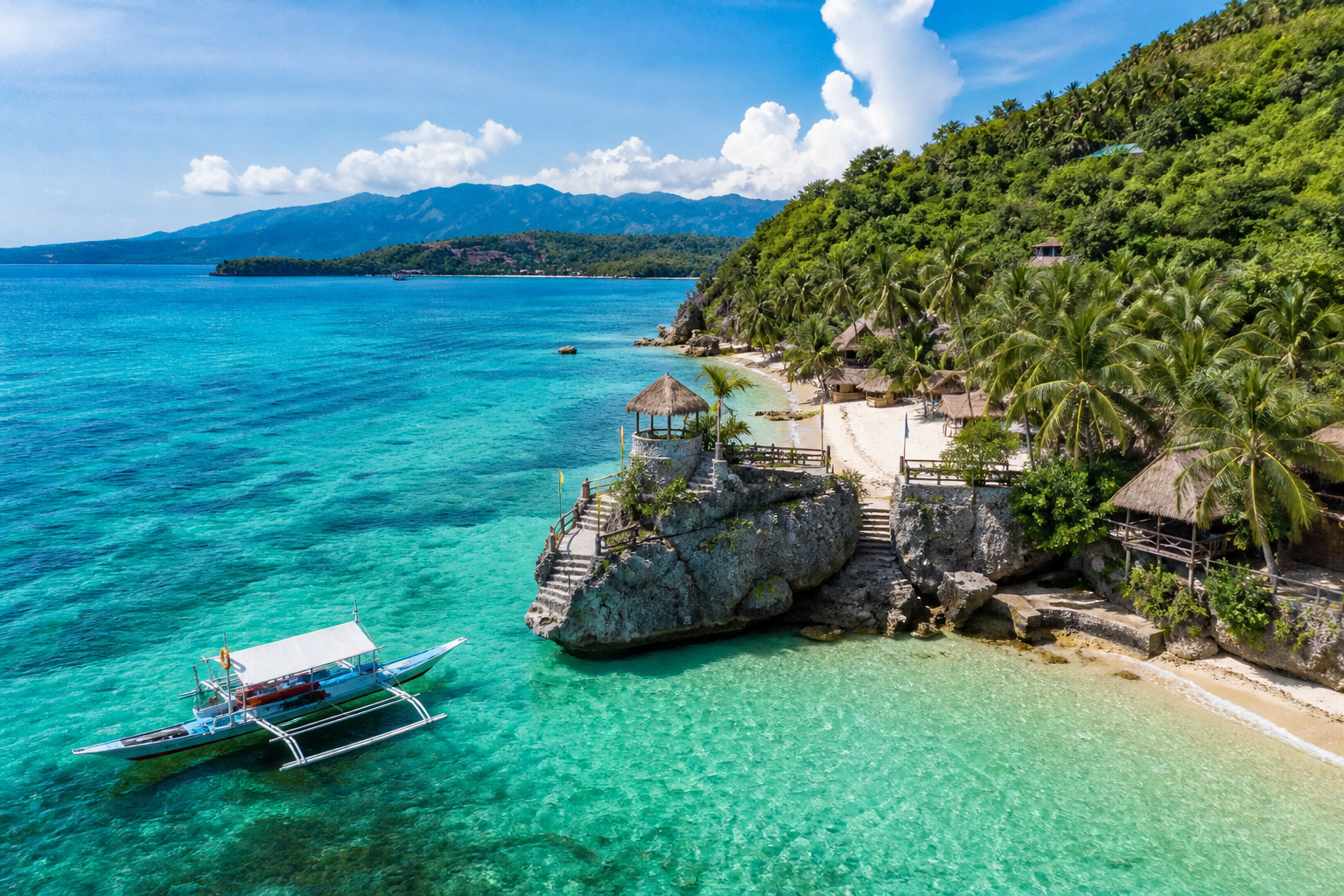
# Cebu and Beyond: My Favorite Island-Hopping Route Through the Visayas
Cebu is often treated as a quick beach stop, but that misses the point. The island is a useful starting place for a much bigger Visayan trip—one that can take you from busy city streets to quiet fishing villages, clear-water islands, old churches, and ferry rides where the sea becomes part of the adventure.
I recently found myself planning days around boat schedules, roadside barbecue, and the question, “Should we stay one more night?” Usually, the answer was yes.
## The Vibe & When to Go
Cebu feels energetic and slightly chaotic in Cebu City, then gradually loosens its grip as you travel south. Outside the city, roads wind past coconut trees, roadside fruit stalls, small churches, and stretches of bright blue water. The island has a practical, lived-in feel rather than being one large resort.
The best general time to visit is **December to May**, when skies are usually drier and sea crossings are more reliable. March to May can be hot, especially inland, while December to February is more comfortable for sightseeing. June to November brings more rain and the occasional storm, so ferry cancellations are more likely.
For a wider Visayas trip, the dry months make it easier to connect Cebu with **Bohol, Siquijor, Iloilo, or Boracay** by ferry or short flight. Still, weather changes quickly around the islands, so I never build a trip around a tight chain of ferry connections.
## Must-See Spots: My Top Picks
### 1. Cebu City’s old center and Carbon Market
Cebu City is not the prettiest place at first glance, but it has plenty of character once you slow down. I like starting around **Basilica Minore del Santo Niño**, Magellan’s Cross, and the old streets nearby. The area is busy, noisy, and full of everyday life—vendors arranging flowers, jeepneys squeezing through traffic, and families stopping for a quick prayer.
Afterward, head toward **Carbon Market** if you enjoy seeing how locals actually shop and eat. It is crowded and not polished, but you can find fruit, snacks, cooked food, and inexpensive souvenirs. Go in the morning, keep your phone and wallet secure, and ask before taking photos of people.
For a calmer view over the city, **Tops Lookout** is popular at sunset. It can be busy, but the view across Cebu and Mactan is still impressive. A taxi or rideshare is the easiest way up.
### 2. Moalboal and the sardine run
Moalboal is one of my favorite stops in Cebu because it gives you a beach town without requiring a luxury budget. The famous **sardine run** happens close to shore, often just a short swim from Panagsama Beach. Watching thousands of fish turn together beneath you feels strangely peaceful, even with other swimmers nearby.
Go early in the morning for calmer water and fewer tour groups. You do not need an expensive boat tour; local guides can arrange a short trip, and some swimmers enter directly from the shore. Bring reef-safe sunscreen, avoid touching the coral, and do not chase turtles if you see them.
The town is compact enough to explore on foot, with small cafés, grilled seafood, and simple guesthouses. At sunset, I prefer grabbing a cold drink near the water rather than booking an elaborate dinner.
### 3. Kawasan Falls and the southern coast
**Kawasan Falls** is famous for its bright blue pools and can get crowded, especially in the middle of the day. The canyoning trips are the main attraction, involving jumps, swimming, and scrambling through the river. They are fun, but only book with an operator that provides proper helmets, life jackets, and trained guides.
If you want a quieter visit, arrive early and skip the busiest canyoning times. The nearby town of **Badian** makes a convenient base, while **Alegria** and **Oslob** offer other southern Cebu stops.
I would think carefully before booking the whale shark tours in Oslob. The experience can be controversial because feeding changes the animals’ natural behavior. If seeing marine life is a priority, Moalboal’s sardines and turtle encounters are a gentler choice.
### 4. Add Bohol or Siquijor by ferry
This is where Cebu’s multi-island idea really comes alive.
From Cebu City, ferries to **Tagbilaran or Panglao in Bohol** are straightforward and usually take around two hours, depending on the service. Bohol gives you the Chocolate Hills, the Loboc River area, quiet beaches, and some excellent countryside roads. I prefer renting a scooter with an experienced rider or hiring a local driver for the day rather than rushing through every attraction.
**Siquijor** takes more planning, but it rewards travelers who like a slower pace. Expect waterfalls, coastal roads, old churches, and small beach bars rather than big nightlife. The island is best explored over at least two or three nights. Ferry schedules can change, so check them locally before leaving Cebu or Bohol.
If you have extra time, **Iloilo** is another good extension. Its food scene, heritage houses, and relaxed riverfront offer a very different side of the Visayas.
## Practical Travel Advice
### Getting there and visa requirements
Most international visitors fly into **Mactan-Cebu International Airport**, which has direct connections to major Asian cities as well as domestic flights from Manila and other Philippine destinations.
For entry, requirements depend on your passport. Many tourists receive visa-free entry for up to 30 days, but not everyone qualifies. In general, you should have:
– A passport valid for at least six months beyond arrival
– An onward or return ticket
– Proof of accommodation or a local address
– The required Philippine **eTravel** registration before arrival
Check the Philippine embassy or immigration website for your nationality before booking. Visa rules and permitted stay lengths can change.
If you are connecting through Manila, allow plenty of time between flights. Domestic and international terminals are not always a quick walk apart, and traffic can make airport transfers unpredictable.
### Where to stay
– **Cebu City:** Best for food, shopping, business, and easy access to ferries. Around IT Park is convenient and modern; the area near the old city center is better for history and local markets.
– **Mactan:** Handy for an early flight or a resort stay. It is less convenient if you plan to explore Cebu City every day.
– **Moalboal:** The best choice for diving, snorkeling, and a casual beach-town atmosphere. Panagsama Beach has the most restaurants and tour operators.
– **Badian:** A good base for Kawasan Falls and canyoning, with a quieter feel than Moalboal.
– **Panglao, Bohol:** Easy for beaches, airport access, and organized tours. Stay a little away from Alona Beach if you want less noise and lower prices.
– **Siquijor town or San Juan:** San Juan suits beach time and restaurants; Siquijor town is more practical for ferries and local errands.
### Getting around
Cebu City traffic can be heavy, especially during morning and evening rush hours. I use **Grab** for airport rides and longer trips when available. Regular taxis are also common, but confirm that the meter is running.
Jeepneys are cheap and part of daily life, though routes can be confusing if you are new to the city. Ask hotel staff or a nearby shopkeeper which jeepney to take. For short trips, tricycles are common outside the main cities.
In Moalboal, most places are walkable around Panagsama Beach. For longer distances, rent a motorbike only if you are confident riding in Philippine traffic. Otherwise, arrange a habal-habal ride or a private driver. Always agree on the fare before setting off.
Ferries are essential for a multi-island trip. Buy tickets from official counters or established ferry companies, arrive early, and keep a little flexibility in your schedule for delays caused by weather.
## Real Costs and Local Tips
The local currency is the **Philippine peso (PHP)**. Cash is still important, especially on smaller islands, though hotels, larger restaurants, and many tour operators accept cards or e-wallet payments.
### Typical daily budgets
**Budget traveler: PHP 1,800–3,000 per day**
– Dorm bed or simple guesthouse: PHP 500–1,200
– Local breakfast or carinderia meal: PHP 80–180
– Street food and casual meals: PHP 100–250
– Jeepneys, tricycles, and shared rides: PHP 100–400
– Basic snorkeling or local activities: extra
**Mid-range traveler: PHP 4,500–8,000 per day**
– Comfortable hotel or private guesthouse: PHP 2,000–4,500
– Restaurant meals and coffee: PHP 800–1,800
– Grab rides, private transfers, or a scooter: PHP 500–1,500
– Tours, entrance fees, and boat trips: PHP 800–2,000
Ferry tickets, diving, canyoning, and flights between islands can raise the daily average, so I keep those separate when planning.
Tipping is not compulsory, but a small amount is appreciated for good service. Rounding up a restaurant bill or leaving PHP 50–100 for a helpful guide or driver is usually fine. Check whether a service charge has already been added.
### A few tricks that saved me money
– **Withdraw cash before leaving major towns.** ATMs on smaller islands may be limited, empty, or temporarily offline.
– **Book ferries directly when possible.** Third-party sellers may add fees, and official schedules are easier to verify at the port.
– **Eat where local workers eat.** Carinderias and small barbecue stalls are usually cheaper and often tastier than restaurants aimed only at tourists.
– **Do not pack every island into one trip.** A delayed ferry can ruin a carefully timed itinerary. Two or three islands done slowly feels much better than five rushed stops.
– **Agree on transport prices first.** This matters especially with tricycles and motorcycle taxis outside Cebu City.
– **Bring a dry bag.** It protects phones and clothes on boat rides, beach transfers, and sudden tropical rain.
Cebu works best when you treat it as more than a single destination. Spend time in the city, head south for the coast, then let the ferries carry you toward Bohol or Siquijor. The travel days may be a little messy, but they are also where the trip starts to feel personal.
KEYWORDS: Cebu Philippines